Soft goods prototyping for a bifold wallet built in muslin and gingham fabric.
Role
Soft Goods Prototyping
Tools
Muslin, gingham cotton, button, sewing machine
Outcome
A two-iteration soft goods prototype of a bifold wallet. Designing the form and pocket layout, learning the sewing machine, and reworking the fabric and closure in a second pass.
Goal
The assignment objective.
Design and create a simple pouch, bag, or other fabric construction. Your design must satisfy a few requirements:
Sketch out a few design concepts and then use the lightweight muslin (low-cost cotton fabric) to prototype your design. This will involve determining the size, shape, and construction method and details. Use the muslin to experiment with how you will cut out and assemble the pieces of your design, and determine the stitching you will need on the sewing machine to accomplish this.
Then, once you have those details worked out, repeat the sewing construction with whatever materials (fabric, fasteners, etc.) you will use for the final version. (If you have enough muslin, you can use that, but it won’t be as visually appealing.)
Design Rationale
A wallet, sized for what I actually carry.
After ruminating between a tote bag, pencil case or wallet, I chose a wallet because I use one daily and wanted more experience sewing multiple pieces together. Its form had to hold credit cards, my ID, and my driver's license comfortably, close securely so cards don't slip, and stay slim enough to fit in a back pocket. Totes and pencil cases felt easier to make, but a wallet is the soft good I actually use, so it was the right time to push myself!
The pocket dimensions were sized against the official CR80 size (3.375 by 2.125 inches), with a 0.25 inch allowance to stop cards from sliding out and for visual appeal. A button-and-loop closure was chosen over velcro or a zipper because the materials were already available and the loop could be sewn from a strip of the same fabric. The wallet was planned initially as stacked in a single pocket.
Sketches
Sizing and construction worked out on paper.
I started by thinking through what I would actually want to carry daily and which soft good would be most useful to build. I considered a pencil case, a phone sleeve, and a small tote, but each of those felt either too simple or too redundant with objects I already owned. A wallet stood out because it is the soft good I use the most, and because it forced me to deal with structural constraints of card sizing and closure reliability.
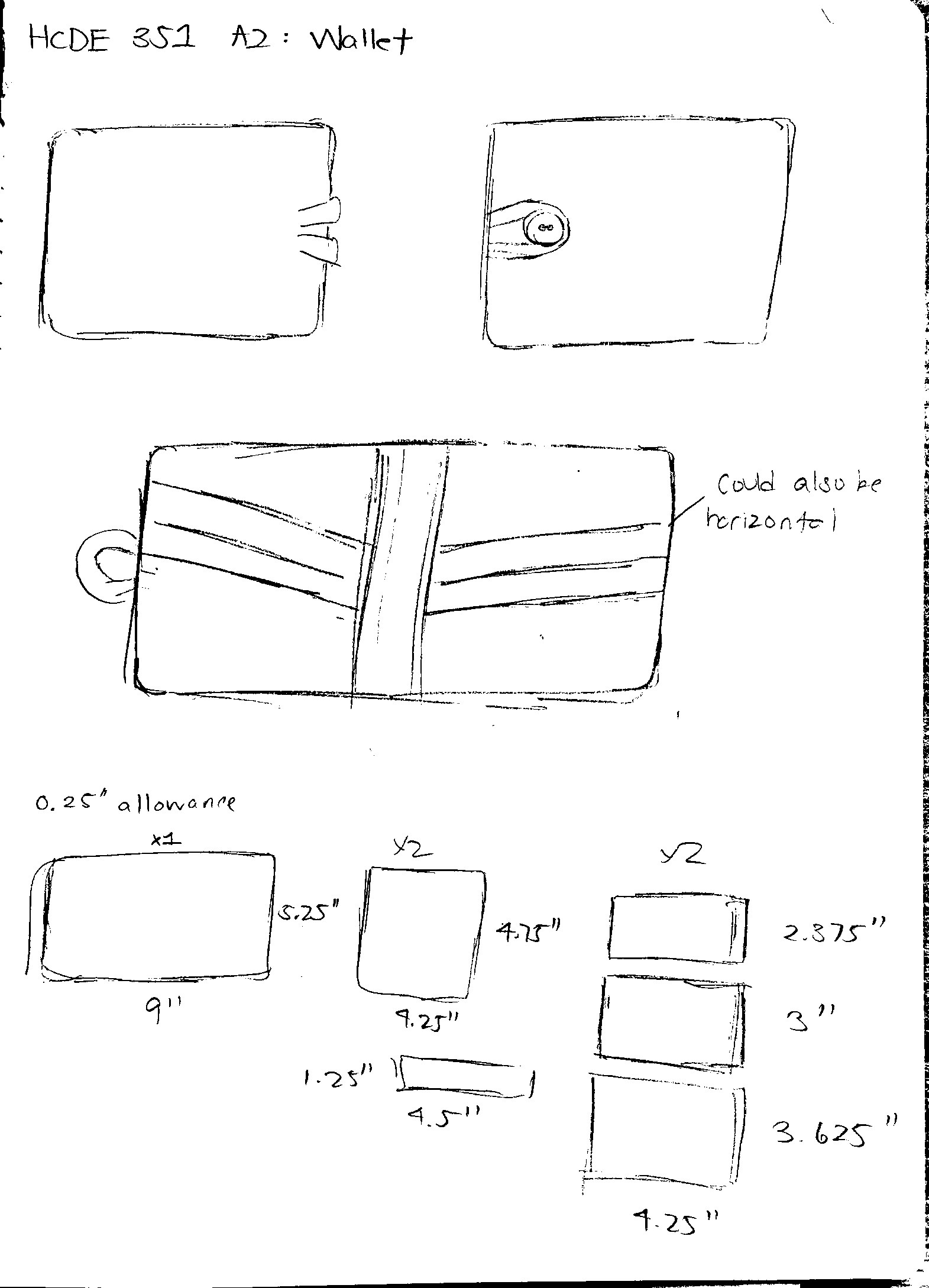
The sketch page breaks into three working areas. The top row shows the outer form from two angles. On the left is a front-view that captures the overall profile with the fabric loop running off the short edge, and on the right is the closed view showing where the button sits against that loop. I drew both because to show the button and loop meeting when the wallet folded shut.
The middle row explores a landscape orientation where the cards sit horizontally across the inside. I I decided to design it this way since a vertical bifold mirrors the way I already open my everyday wallet, and the loop falls naturally along the short edge where a button can sit flat without catching on a pocket.
The bottom row is where the actual cutting plan lives. I looked up the official ID-1 card dimensions (3.375 by 2.125 inches) and added a 0.25 inch allowance to every pocket edge so cards could slide in without catching. That gave me nine panels to cut: one outer shell at 9 by 5.25 inches, two interior lining panels at 4.25 by 4.75 inches, two short card pockets at 4.25 by 2.375 inches, two medium card pockets at 4.25 by 3 inches, two deep lowers pocket at 4.25 by 3.625 inches, and a narrow loop strip at 4.5 by 1.25 inches. The narrow loop strip gets folded in on itself and stitched along the edge to form the fabric cording that wraps over the button.
First Iteration
First iteration in gingham fabric.
I started with the gingham fabric instead of muslin, since the gingham was what I had ready to cut. This version was a smaller scale test of the construction method. I cut the outer shell and a single interior lining with one card pocket, sewed it together on the machine using a straight stitch along the outer edges, and added the button-and-loop closure centered on the right edge of the front panel.
Centering the button on the long edge turned out to be the strongest part of this iteration. The closure held the wallet shut from the middle, so both sides stayed flat against each other without wanting to fan open. The weakness was capacity. With only one interior pocket and no lining on the opposite side, the wallet could not hold my real card load, and the gingham panels were visibly uneven where I had not yet gotten the hang of feeding fabric through the machine at a consistent speed.
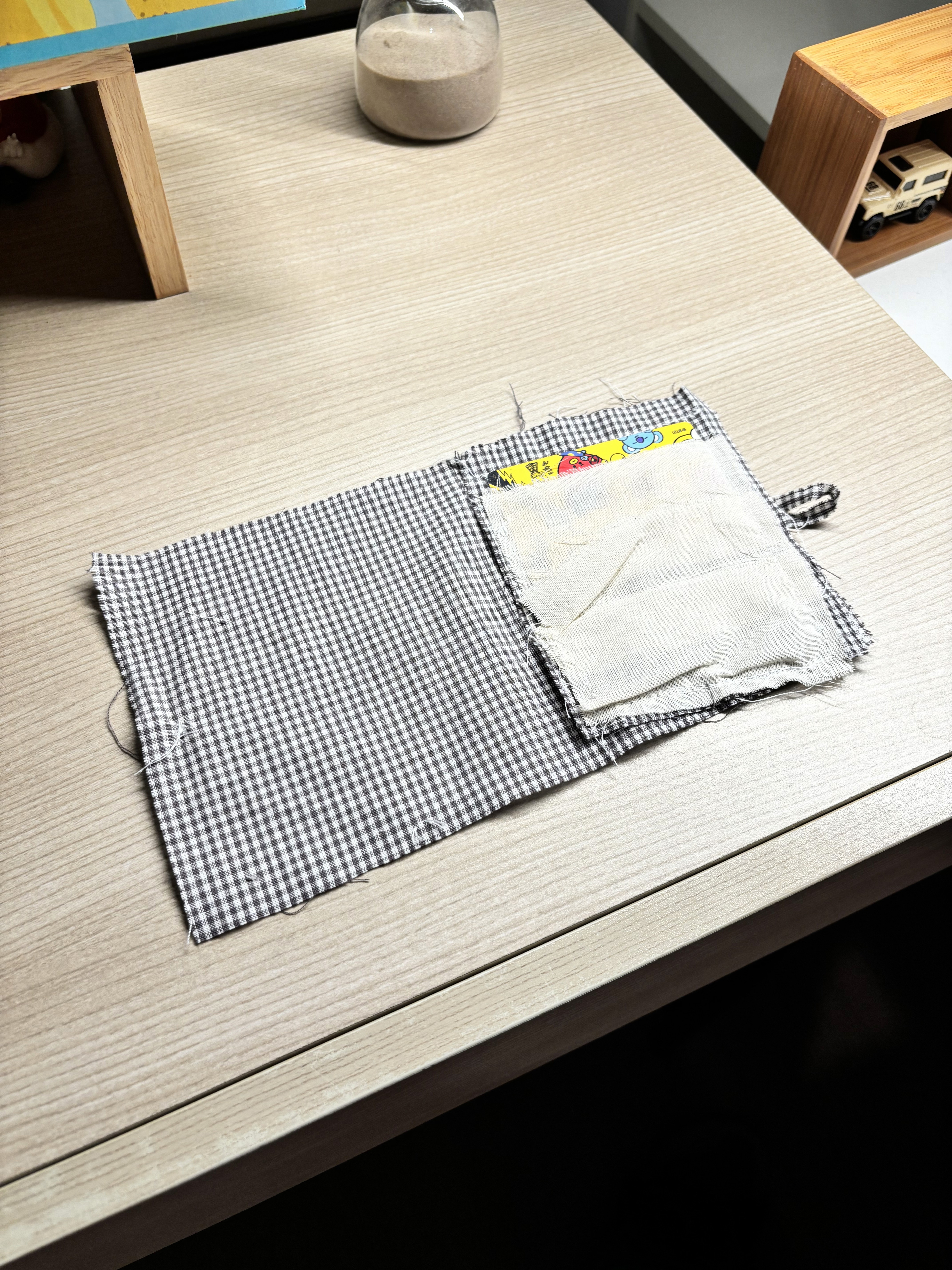
Gingham interior, showing the single card pocket and the closure loop on the right edge. The lining sits only on one side of the bifold, leaving the other panel unlined.
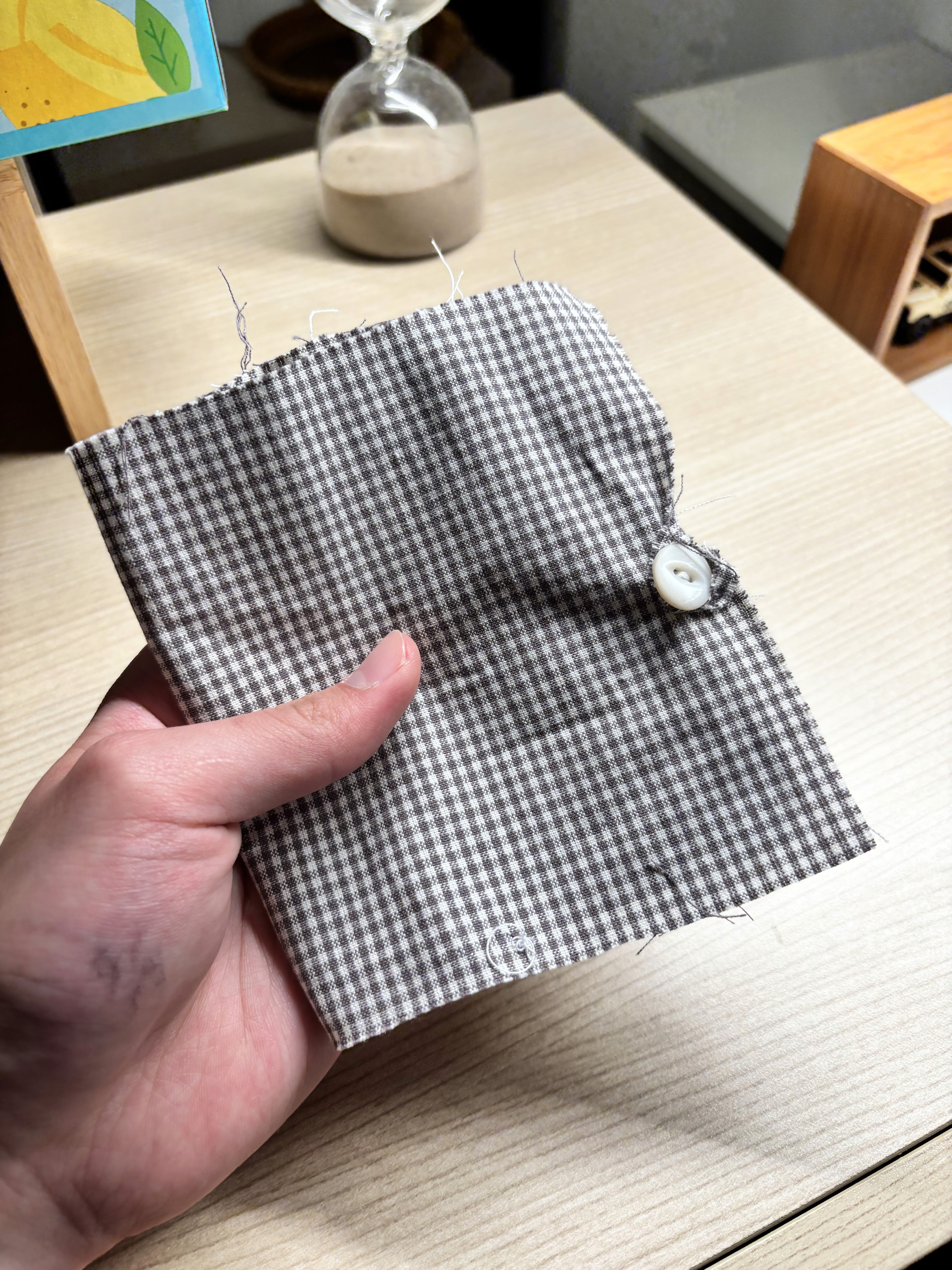
Closed view with the button fastened. Centering the closure on the long edge kept both panels tight against each other, which I preferred over a top-edge closure for flatness.
Final Iteration
Final iteration in muslin.
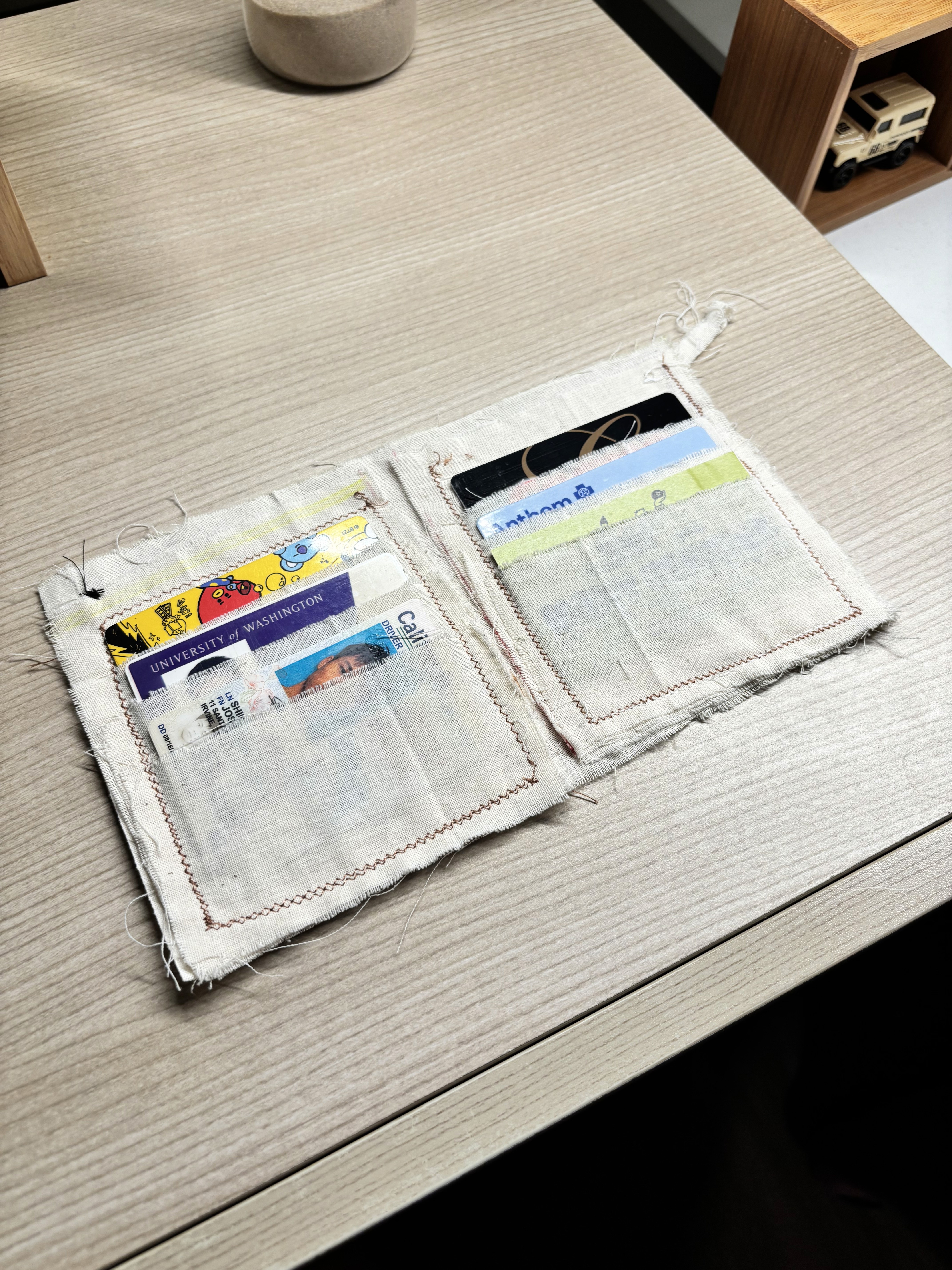
The final iteration was sewn in muslin and built out the full bifold layout. Both interior panels received linings with three pocket layers on the left and right side and tucked pockets behind the panel. All pocket dimensions were cut to the ID card + allowance measurements from the sketch. I used a zigzag stitch throughout to resist fraying along the raw muslin edges, and sewed the button-and-loop closure onto the top edge.
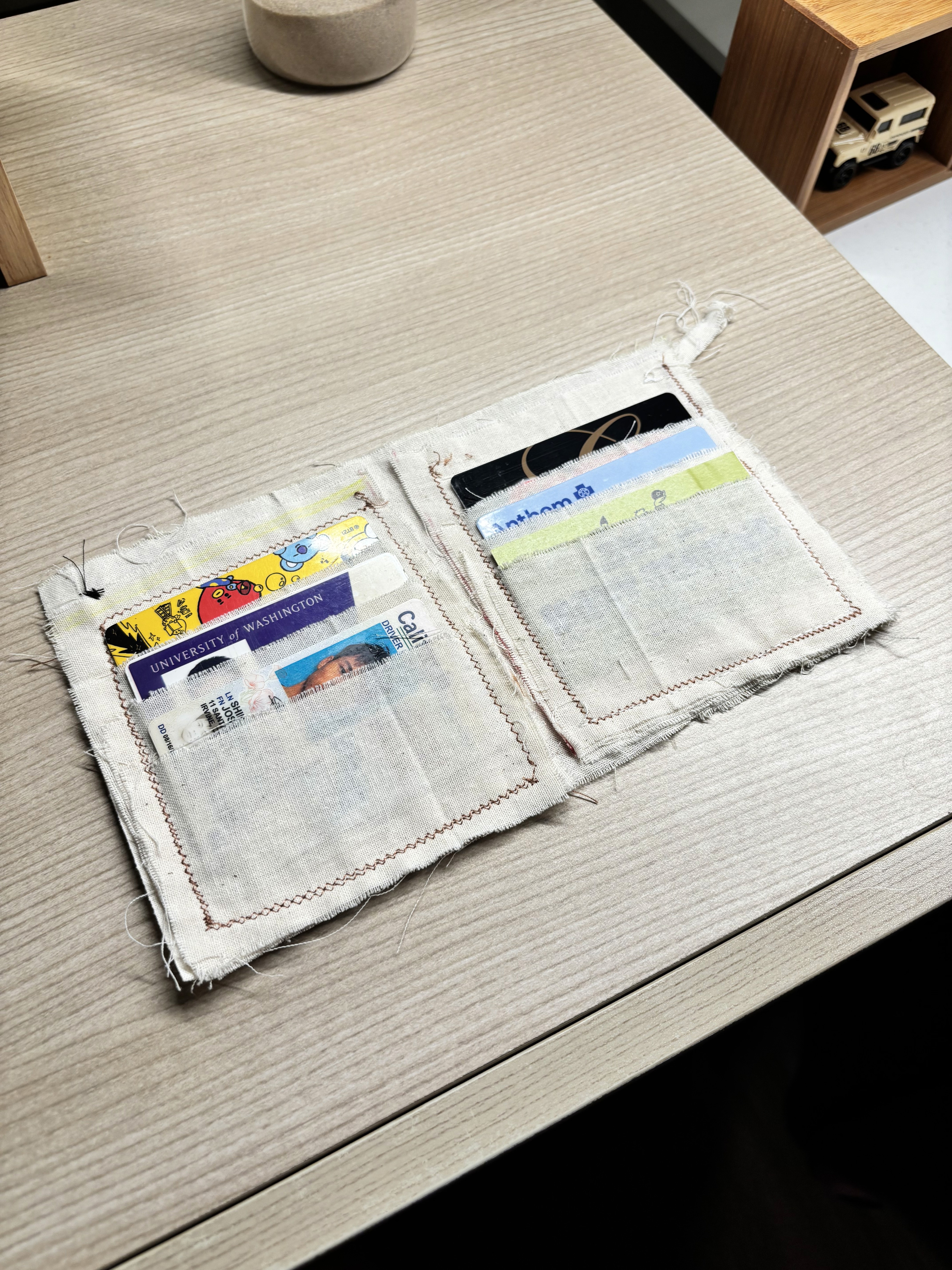
Muslin wallet opened flat, both interior panels lined with dual pocket layers. Left side holds IDs, right side mirrors the layout for other cards.
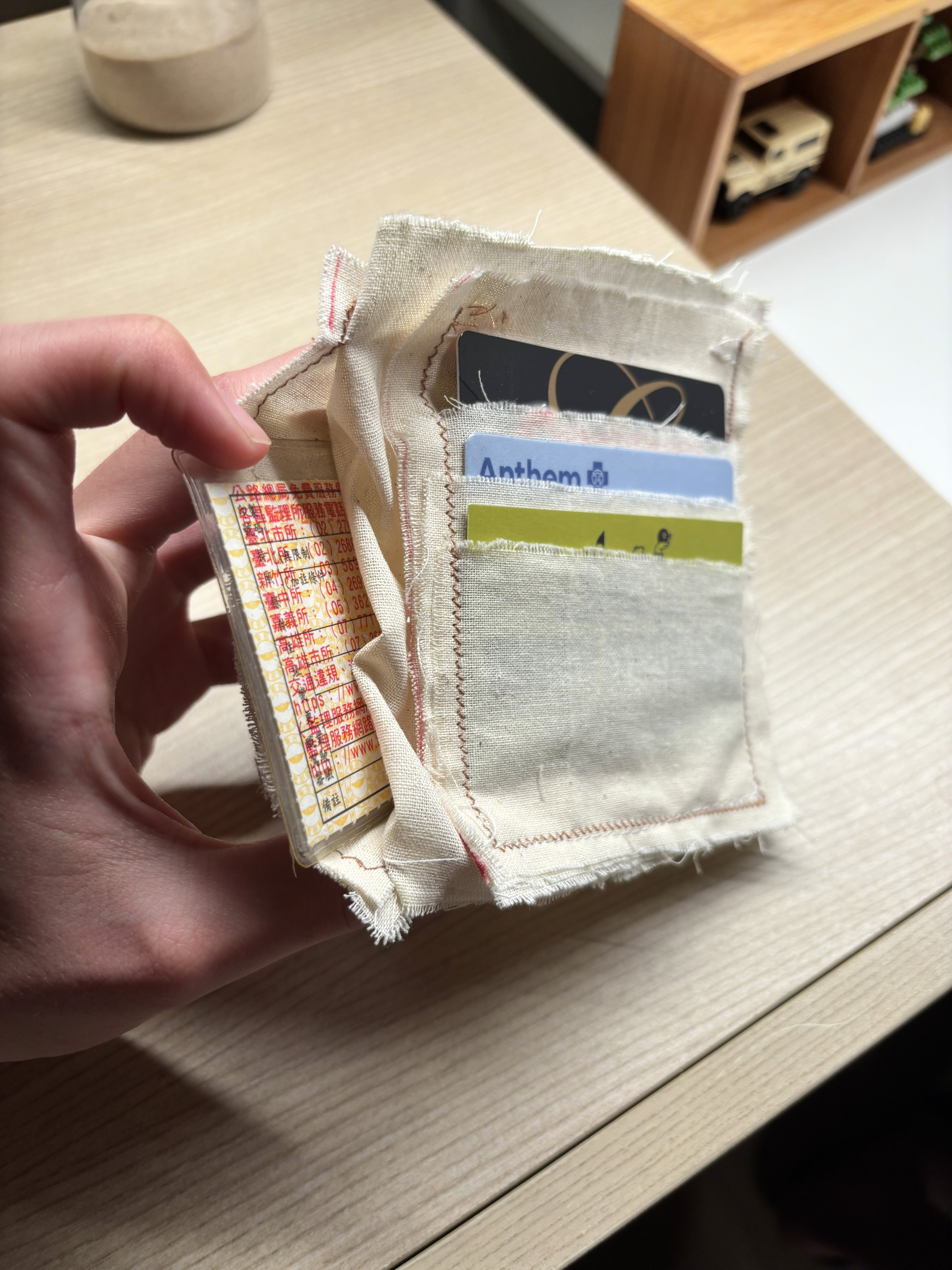
Interior angle showing the layered pockets loaded with cards and a hidden pocket. This picket accommodates the larger cards.
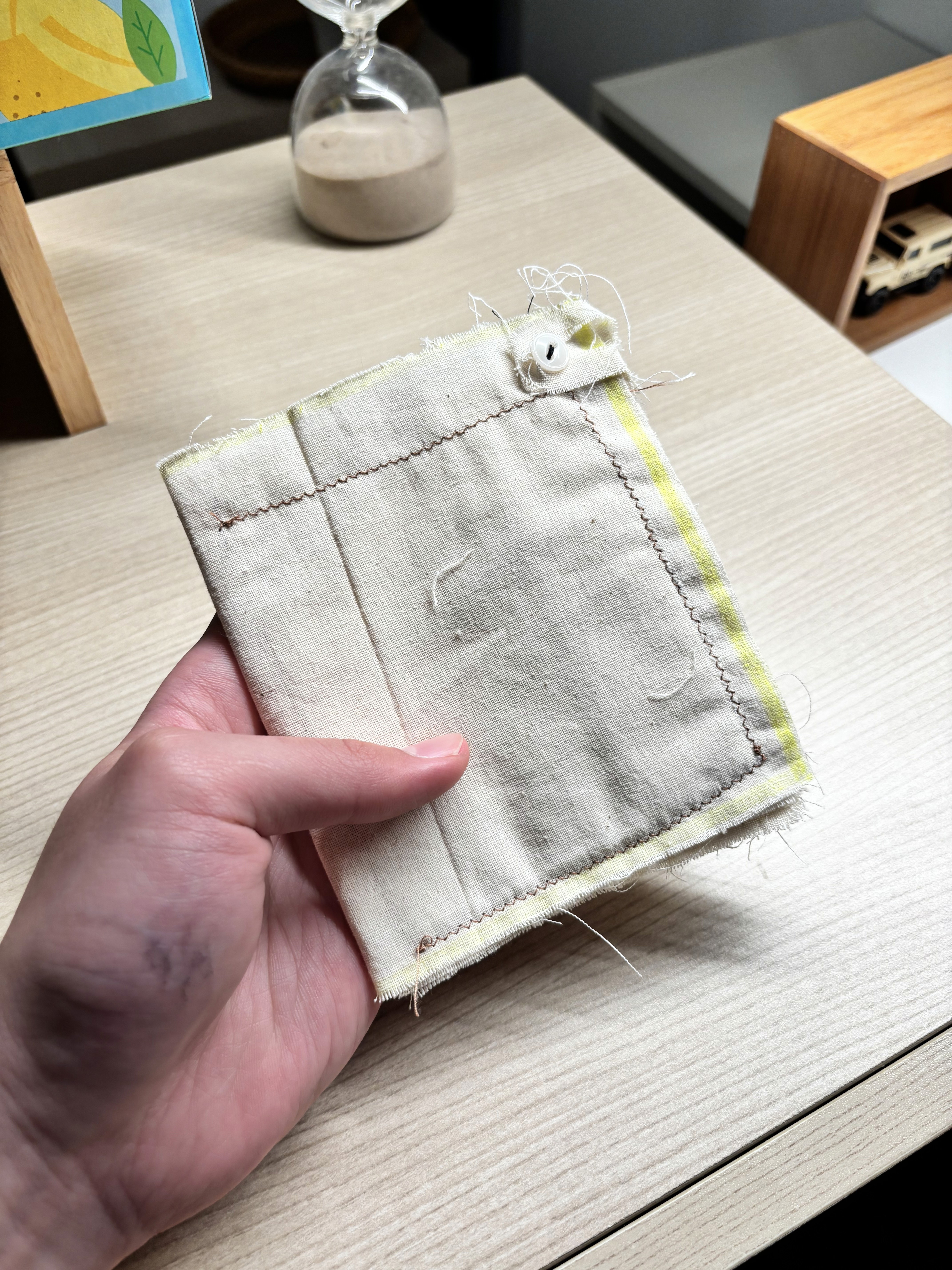
Final muslin wallet closed with the button fastened at the top edge. The top-positioned closure was the main construction change from the first iteration, where the button sat on the long side.
Construction moved faster because I became more familiar with the machine settings were dialed in from the first iteration. I backstitched each pocket opening to stop the corners from pulling loose under card pressure. The bifold panels were sewn together along the spine as the last step.
Moving the button closure from the long edge to the top was a decision I made for card capacity. The loaded wallet needed the full long edge free to sit flat against itself, and a top closure kept that edge unobstructed. That tradeoff turned out to be a mistake, which the critique and roommate feedback both caught.
Analysis
What worked, what didn't, what's next.
The two iterations succeeded differently. The gingham first prototype nailed the closure placement, with the centered button on the long edge keeping both panels tight against each other. But the single card pocket and half-lined interior meant it could not hold what I actually carry. The muslin final prototype inverted that balance, with full dual-sided pocket capacity and ID-sized dimensions, but a top-edge closure that did not hold the wallet shut nearly as well.
I showed both prototypes to my roommate, who is reliably blunt. His first observation was about build quality, where the frayed edges, visible thread tails, and uneven stitching around the pocket openings made the wallet look unfinished, and his read was that it would not survive a week in a back pocket. His second observation was about the closure on the final muslin version. With the button at the top, the long edge wanted to fan open whenever cards were loaded, and he preferred the centered button on the first prototype. His third observation was about the fabric choice. Muslin is too flimsy for a wallet, in his view. It absorbs moisture, wrinkles easily, and does not have the structure a wallet needs to protect its contents.
The in-class critique echoed these points, but framed it differently. Classmates focused on the interaction of opening and closing. They noted that a top-edge button means the wallet has to be reoriented to open, whereas a side button lets you open the wallet in its natural orientation. One classmate pointed out that the muslin final prototype's dual pockets were genuinely well-sized and that the ID fit snugly, which validated the measurement work from the sketch phase. The strongest critique note was that the raw muslin looked like a prototype material rather than a finished good, with the same construction in a heavier canvas or denim significantly changing the perception of quality.
Feedback aside, my own reflection on the two iterations is that I optimized the wrong variable between them. I moved the button to the top of the muslin prototype because I thought the long edge needed to stay flat for card loading, but the centered closure from the first prototype was already doing more important structural work than I had thought. I also underestimated how much appeal the fabric choice carries. Muslin made the construction faster and the stitching more forgiving, but it also capped how finished the final prototype could feel regardless of how careful the sewing was. If I had held the first prototype's centered closure as a fixed constraint and iterated only on pocket layout and fabric, I think the second version would have landed much closer to a wallet I would actually carry.
For a third iteration, the changes I would make fall into groups. Construction changes come first. I would move the button back to the edge center, which addresses both my own reflection and the roommate and critique feedback about the closure fanning open. I would also finish the edges properly with a folded hem rather than leaving raw zigzag, which directly addresses the build-quality observation about frayed threads and the critique point that the wallet looked like a prototype material. Fabric changes come second. I would switch to a heavier canvas or waxed cotton so the wallet has enough body to protect its contents and resist wrinkling, keeping muslin as the internal lining where its softness helps cards slide in cleanly. Layout changes come last. I would keep the ID-sized pocket dimensions from the final iteration since those were validated by both the critique and by how well my real cards fit, but I would add a single billfold slot across the spine, since the current design has no home for folded cash. The synthesis across all of these is that the first prototype's construction choices were closer to right than I gave them credit for at the time, and that iterating fabric and layout without breaking its closure would have been the stronger path.