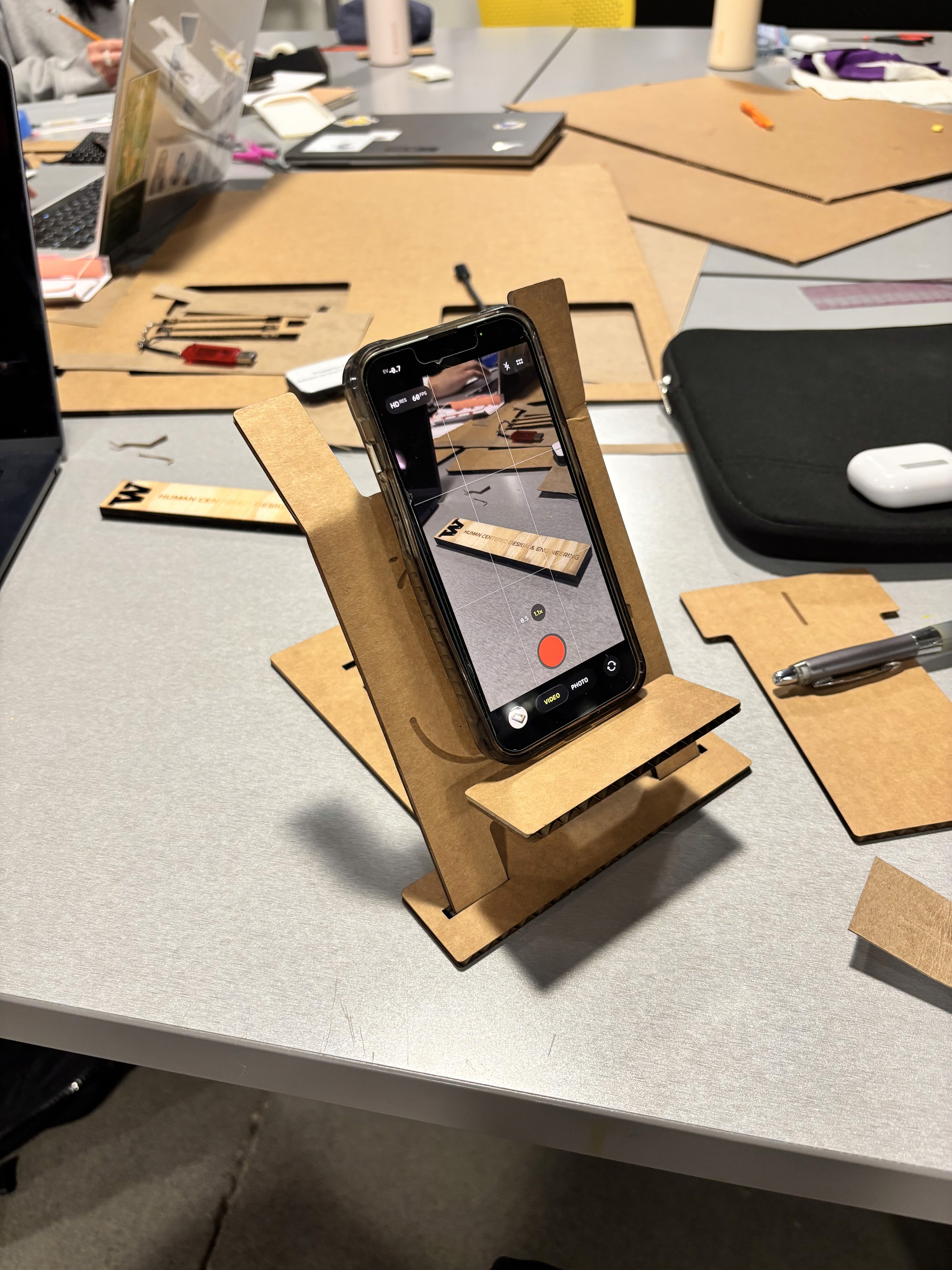
A laser cut corrugated pad phone stand made for shooting top-down videos.
Role
Laser cut prototype
Tools
Cardboard, flute, laser cutter
Outcome
An adjustable phone stand designed for shooting video. Hand-cut cardboard iterations, a Cuttle parametric model, and a final laser-cut corrugated pad version with a dog face etched on the front.
Goal
The prototype objective.
Your challenge is to design and build an object you can use in your prototyping work—a tool for your process. You have three choices of simple objects to create. Select one of these:
A cell phone stand for shooting video of an object below it (such as a paper prototype or mobile app)
A laptop or tablet stand to hold it upright or in some useful position
A smartphone or tablet paper prototyping frame that you can use for a usability test (e.g., to hide the tablet frame and only show the screen)
Regardless of your choice of object, your design must satisfy these 3 requirements:
Must be cut from not more than two sheets of 18 x 24" flute and/or two sheets of chipboard (we will provide these to you). If you wish, you may combine these materials in your design.
Must not use any glue, tape, or other fastening materials to assemble and use
Must be able to be disassembled into pieces that can be stored flat and transported (as in a backpack)
No downloaded designs. The structure and design must be of your own conception. You may however, decorate your enclosure with existing patterns and styles. If you do, you must provide a link to the source artwork in your submitted files. For example, if you download a floral pattern to etch on the surface, you include that source file or a link to it in your drawings.
Design Rationale
Why a phone stand, and why a dog.
I chose the phone stand since I film paper prototypes for usability tests fairly often, and an adjustable stand for top-down recording is something I would actually keep using. The other two options would have ended up in a drawer…
Beyond the assignment requirements I set three personal specs. The stand had to hold a 200g iPhone 15 Plus with case at three viewing angles (usability), stand up unloaded without tipping (usability), and have a visual element I would enjoy looking at (desirability). The dog face came from the silhouette. The mouth slit doubled as the cutout for the shelf, and the shelf read like a tongue. Once I noticed this fun possibility after my first iteration, I committed to it.
Sketches
Two sketches before any cuts.
I started with a wide concept consideration with my name etched on the backrest, then narrowed to a single direction once the silhouette began looking like a dog. The first sketch worked through three structural ideas in parallel, having the ideal prototype along with the flute and cardboard ones. The second sketch locked in dimensions for the version I was about to build.
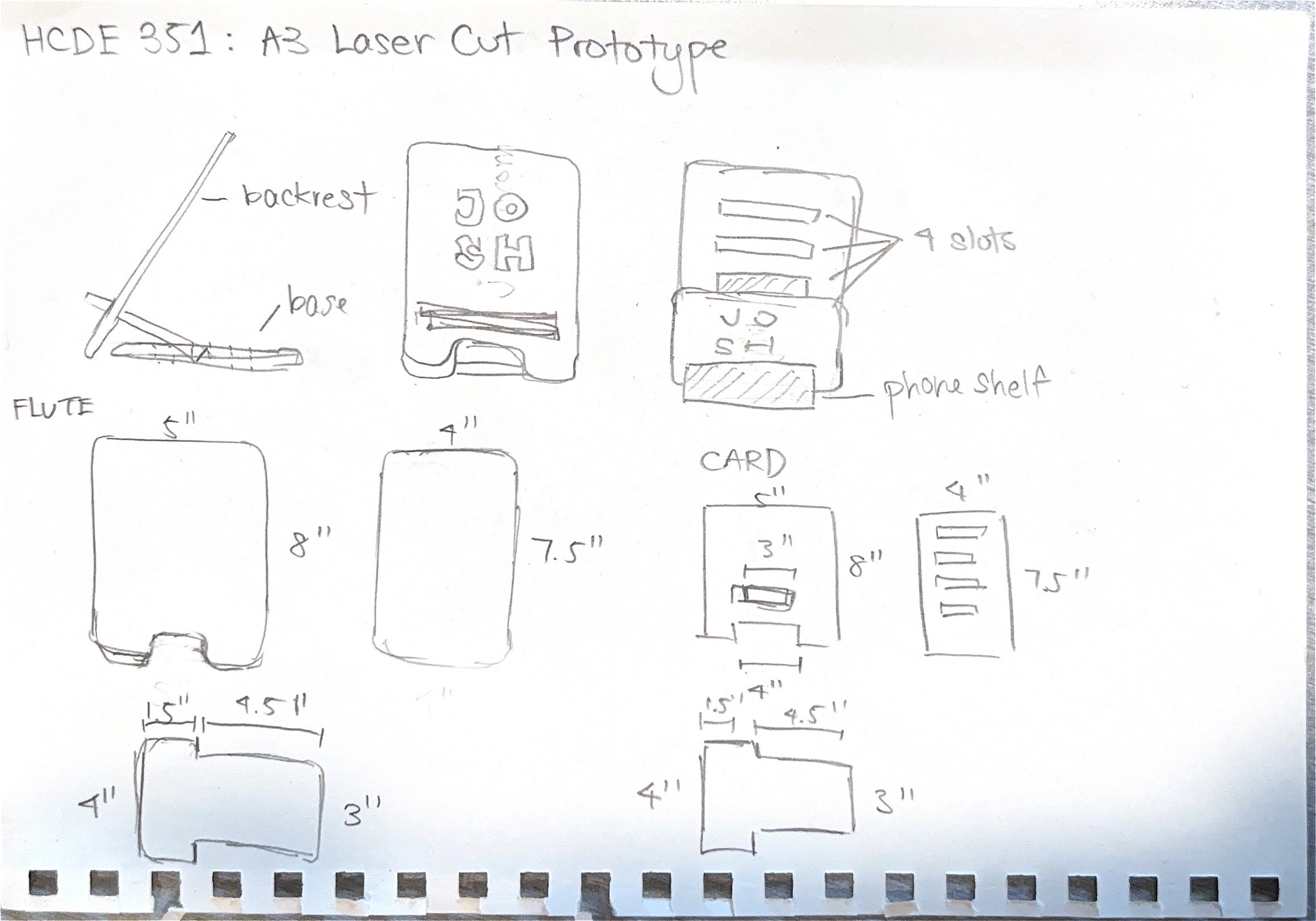
First sketch. Three prototypes explored side by side, each with notes on the backrest, base, and how the cut pieces would slot together. Initial backrest and base sizes called out at 5×8" and 4×7.5", for example.
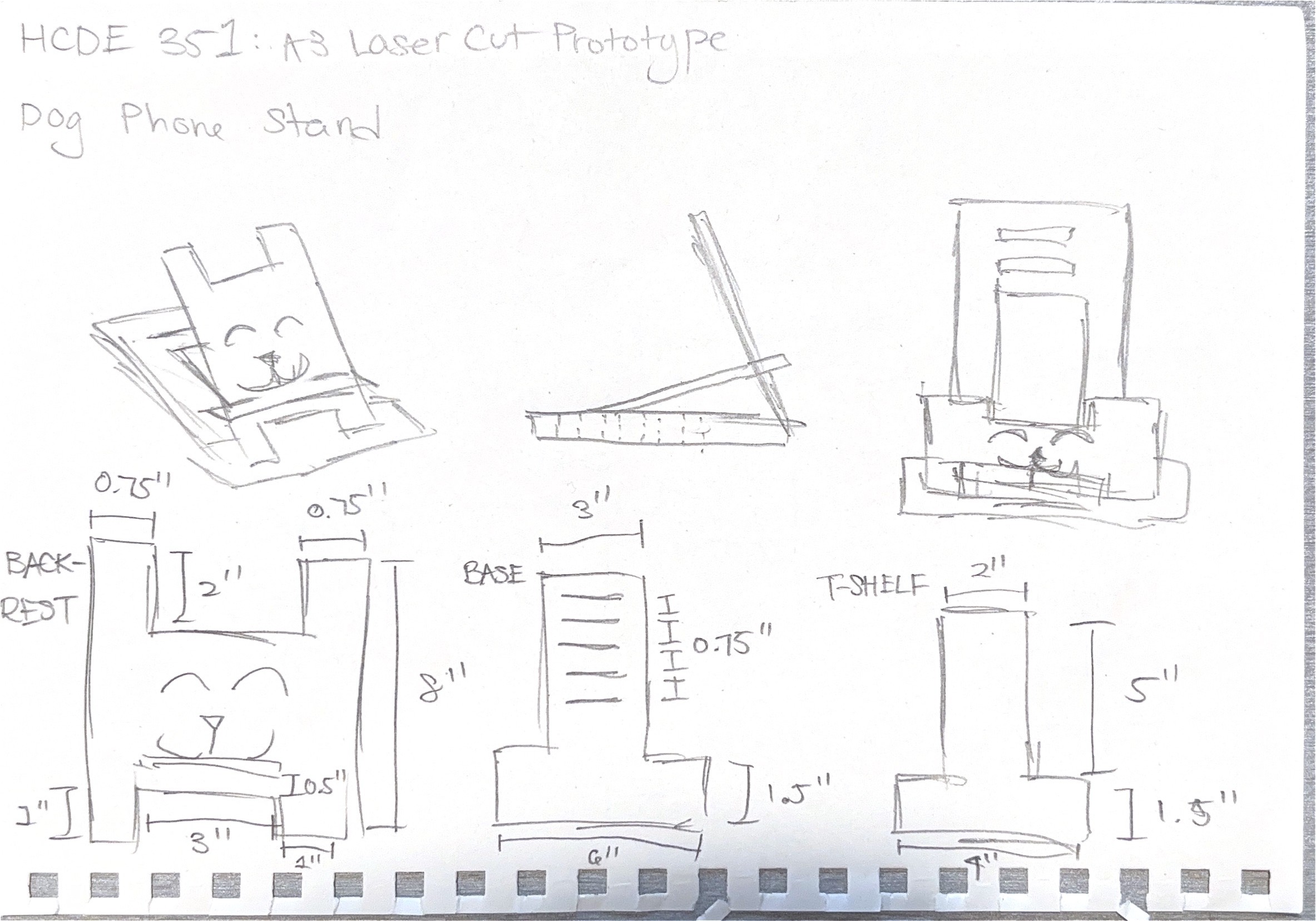
Second sketch. Refined dog phone stand with the dimensions that went into the build. Backrest at 8" tall with 0.75" ear tabs, base at 6" wide with four 0.75" angle slots, and a 5" tall T-shelf for the phone.
First Iterations
Two cardboard rounds before the laser.
V1 was hand-cut cardboard. The backrest, base, and T-shelf all worked individually, but the base was missing slots for the backrest. Without those slots, there was nothing to hold the backrest in place at angle.
V2 was the second cardboard cut with the missing slots added. The stand stood. A mock paper phone sat in the shelf at angle. But the cardboard was thin enough that the joints sat loose, and pieces wobbled.
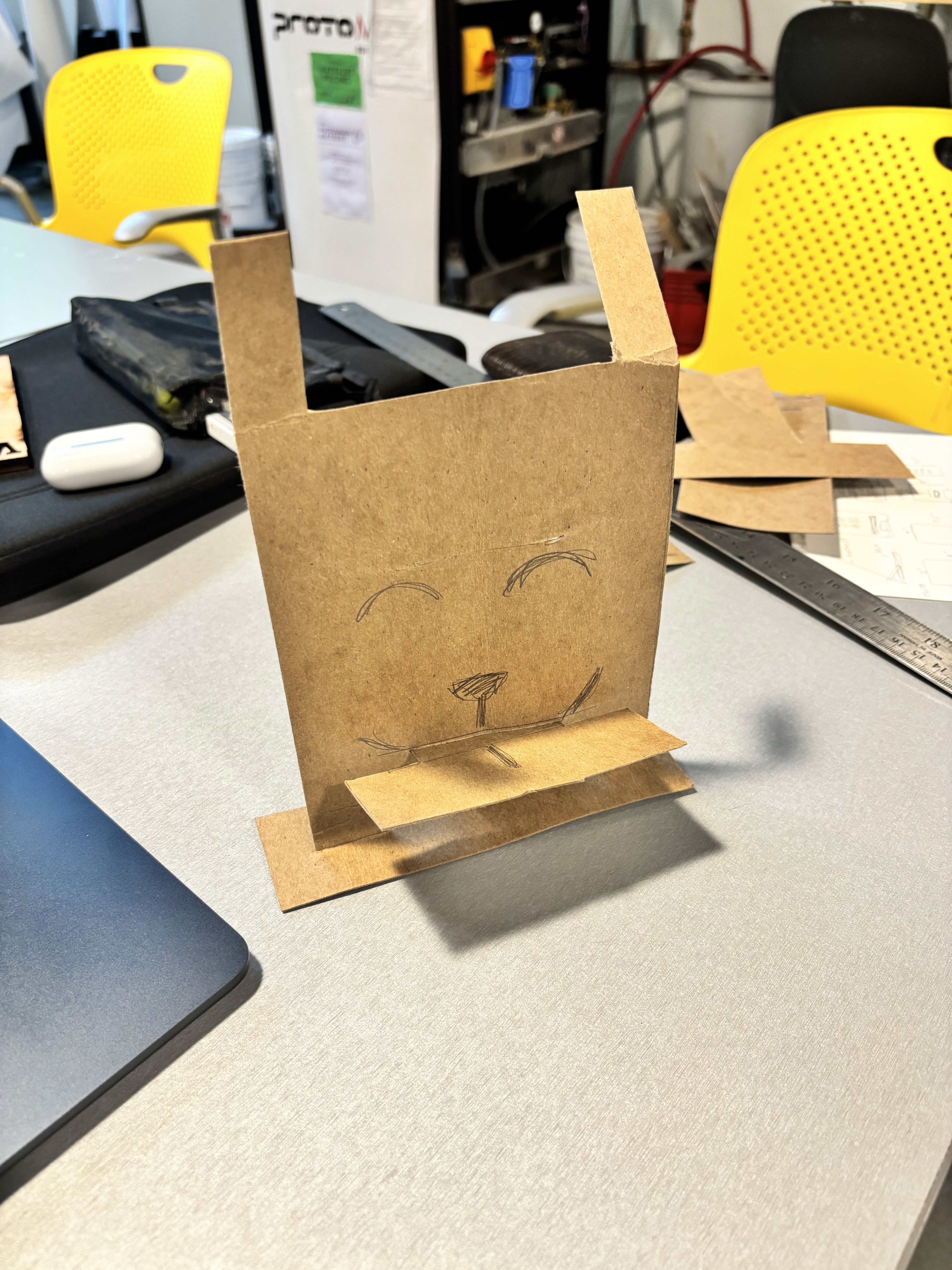
Chipboard V1. Hand-cut backrest, base, and T-shelf with the dog face inked on the front. The base was missing slots for the phone shelf piece, so the shelf would not lock at angle.
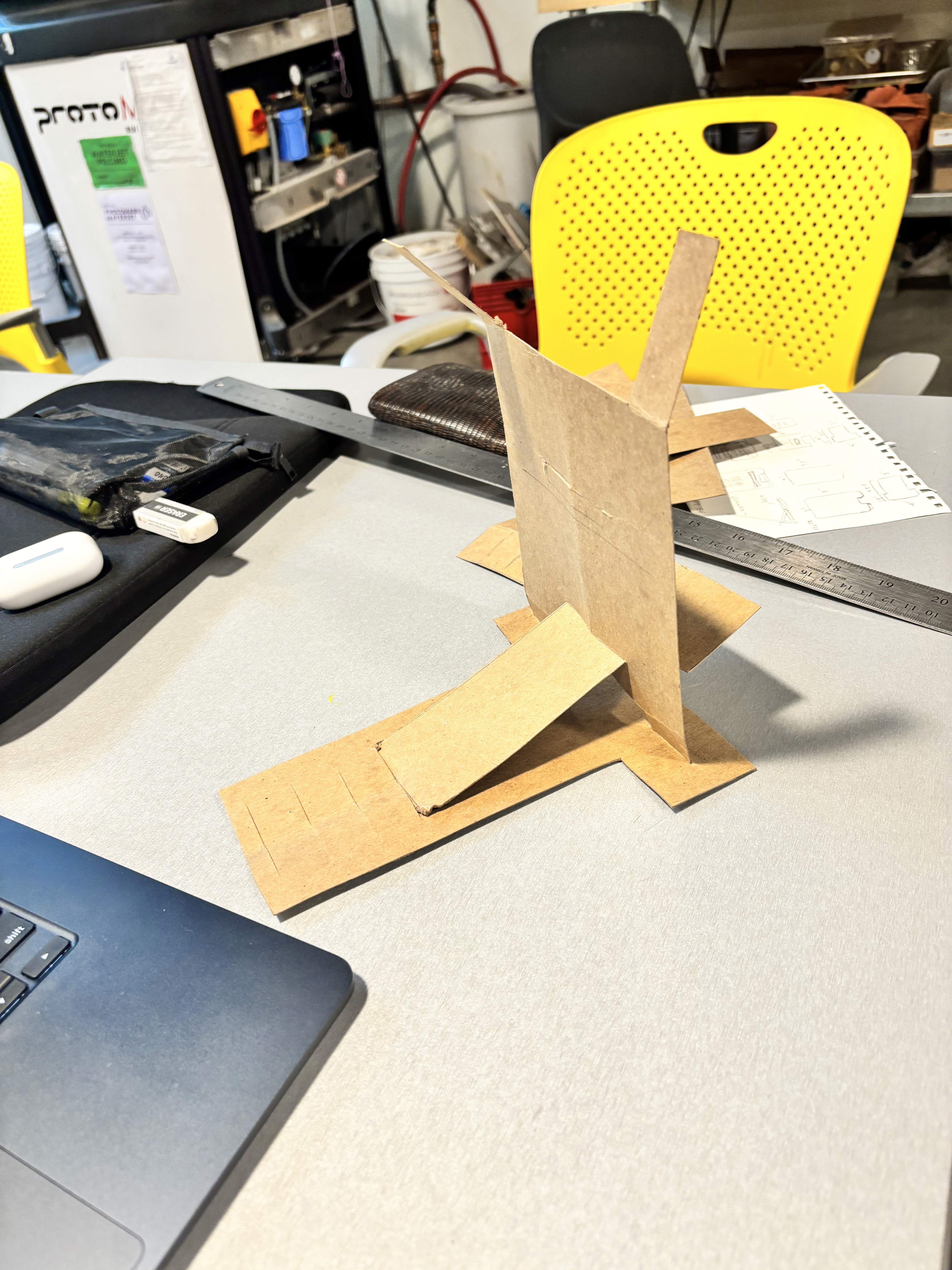
Chipboard V2 from the side. Slots for the backrest added to the base. Phone shelf locked in at angle, but the chipboard was thin enough that the prototype was flimsy.
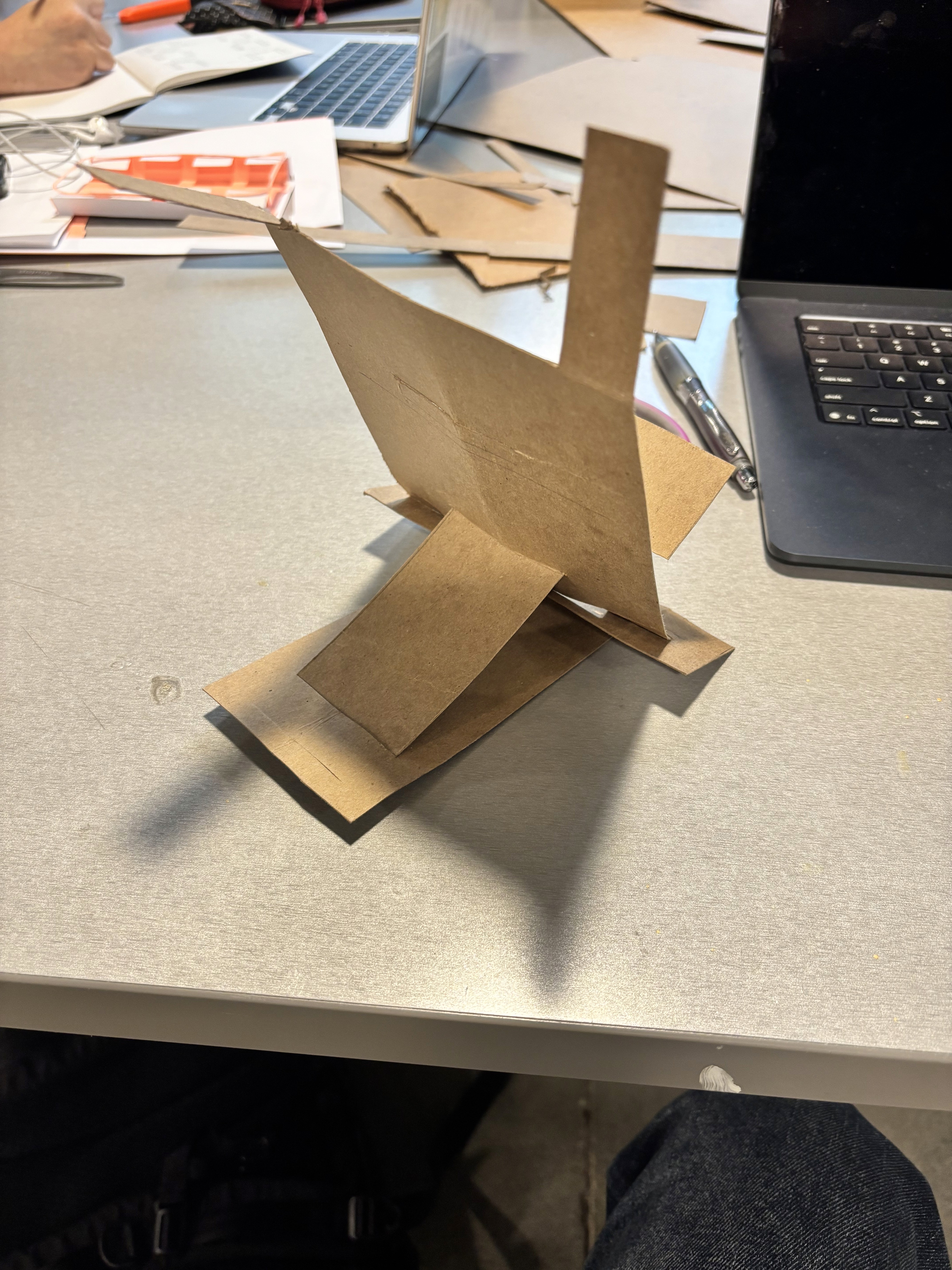
Chipboard V2 from the back. Backrest leans onto the angle adjuster. Visible sag, even with no phone weight.
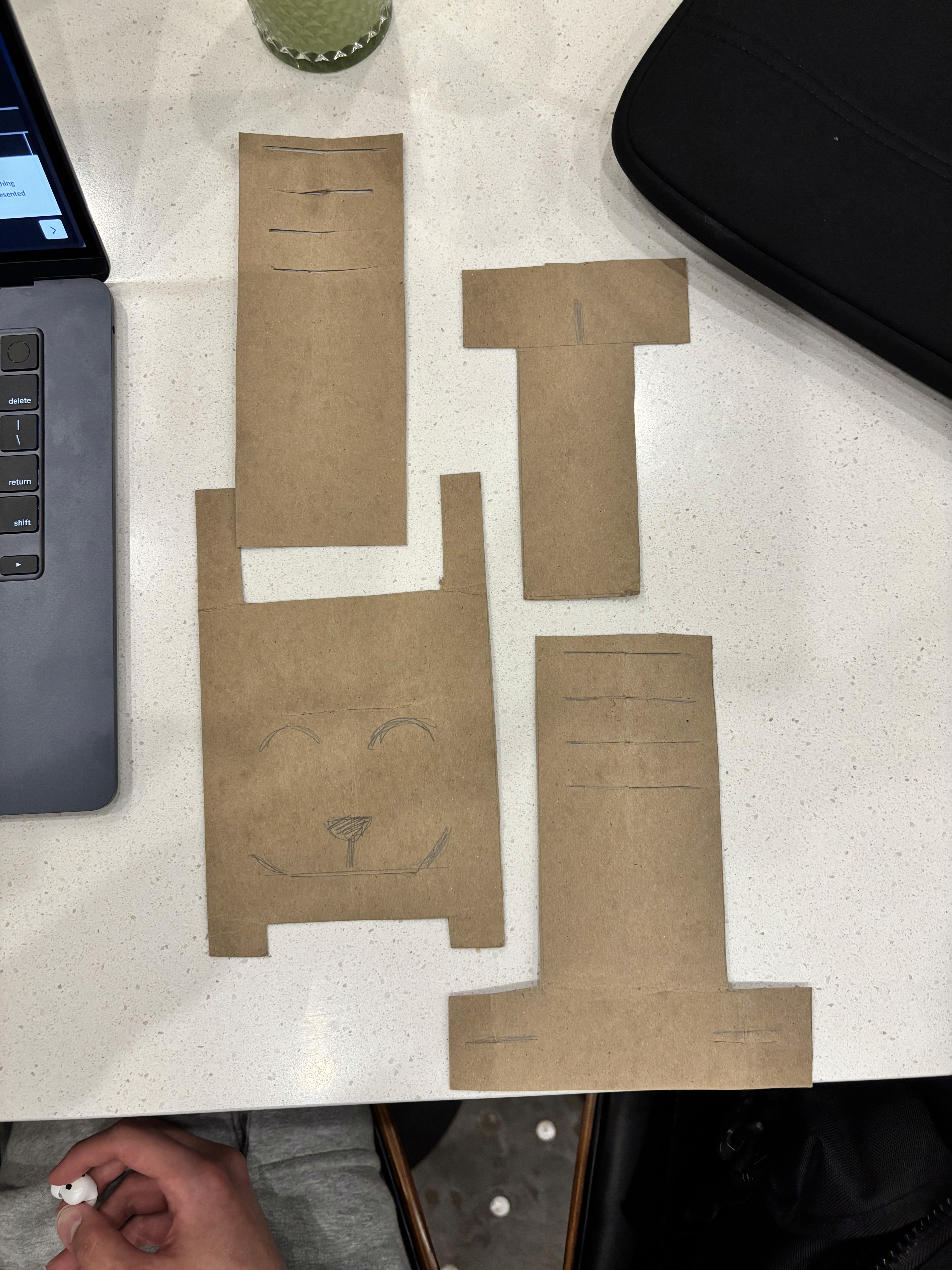
Chipboard V2 disassembled and laid flat. The disassemble-and-stack requirement felt good!
Each cardboard pass with measurements took a few minutes with scissors. The base slot omission probably would have cost an hour if I had only caught it after burning a sheet of flute, considering the lengthy line for the laser cutter. Building cheap first was the safest way to tackle the project.
Two chipboard rounds was enough confidence to model the stand in Cuttle!
Final Prototype
Cuttle and the laser cut.
In Cuttle I drove every joint width from a single parameter so I could tune slot tolerance once and have it propagate. Since the corrugated pad was 5/32" thick, I allowed a bit of tolerance and made each slot 0.16". The dog face etching sat on the backrest with the eyes as curves, the nose as a filled triangle, and the mouth as a smile. The full layout fit on a single 18×24" sheet of flute.
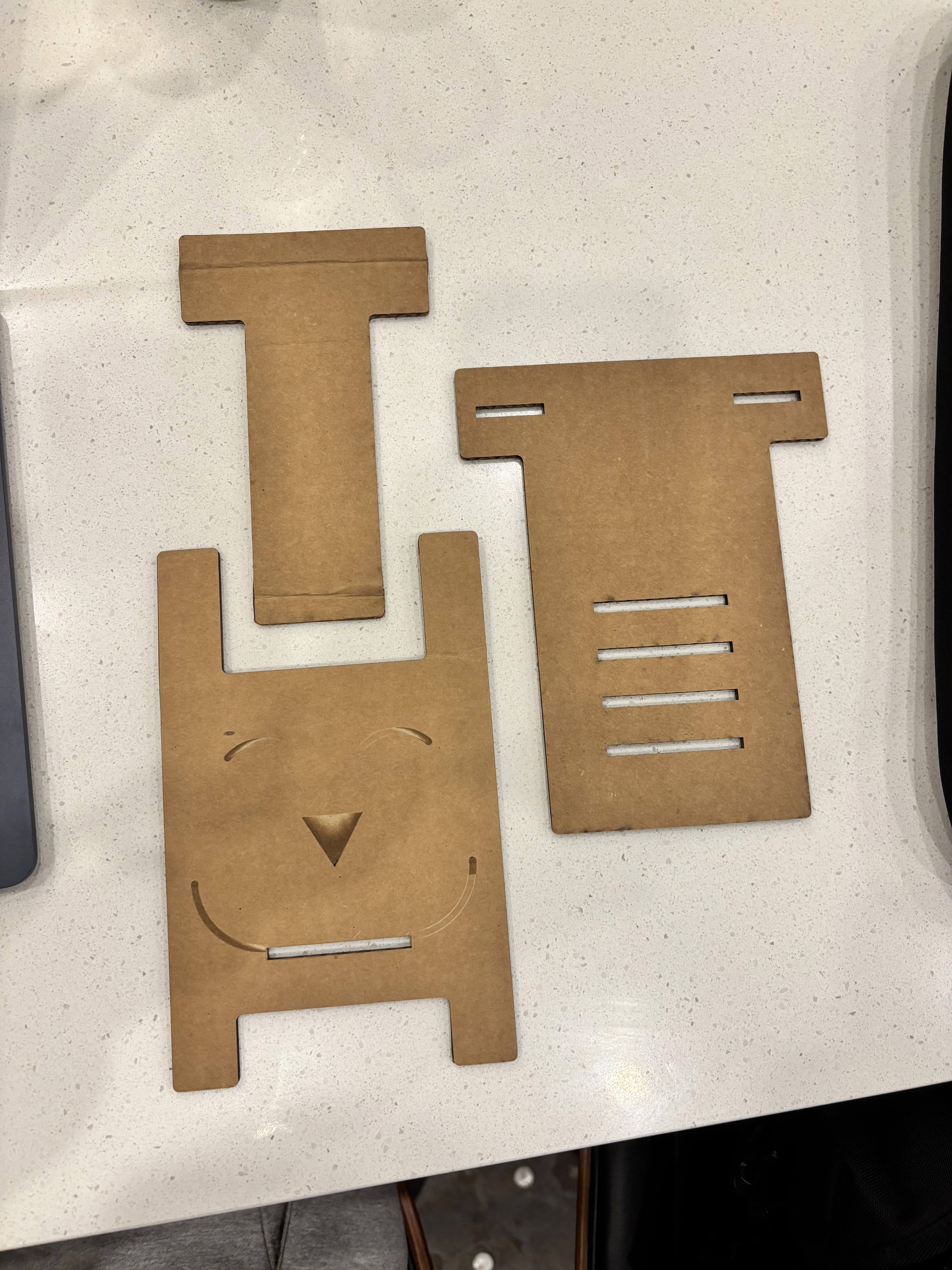
Laser cut flute pieces. Three components: backrest with the etched dog face, base with four angle slots, and the T-shelf. Disassembles flat for the backpack.
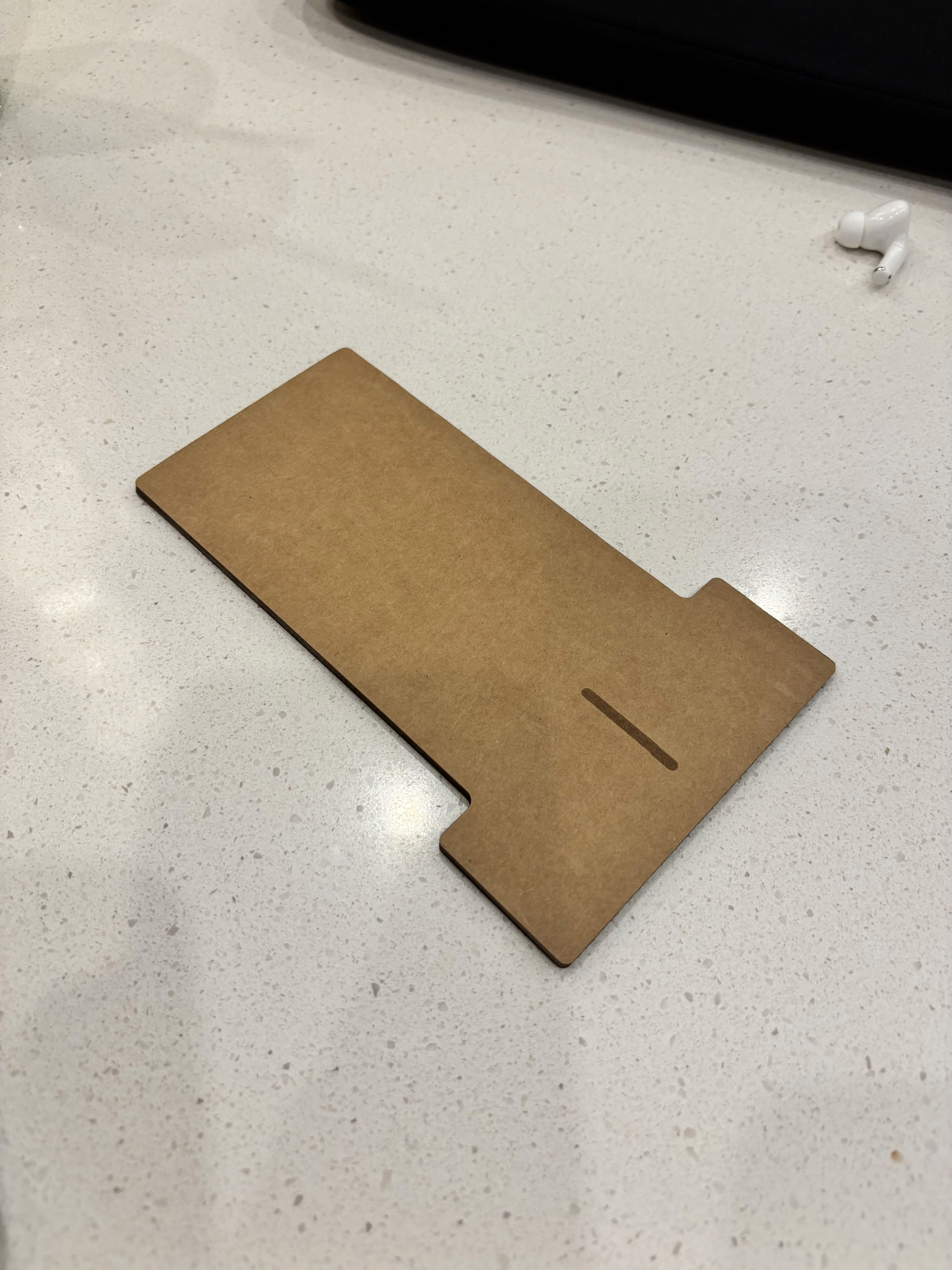
The miscut shelf, 1 inch too wide. Caught after the cut, recut at the correct width.
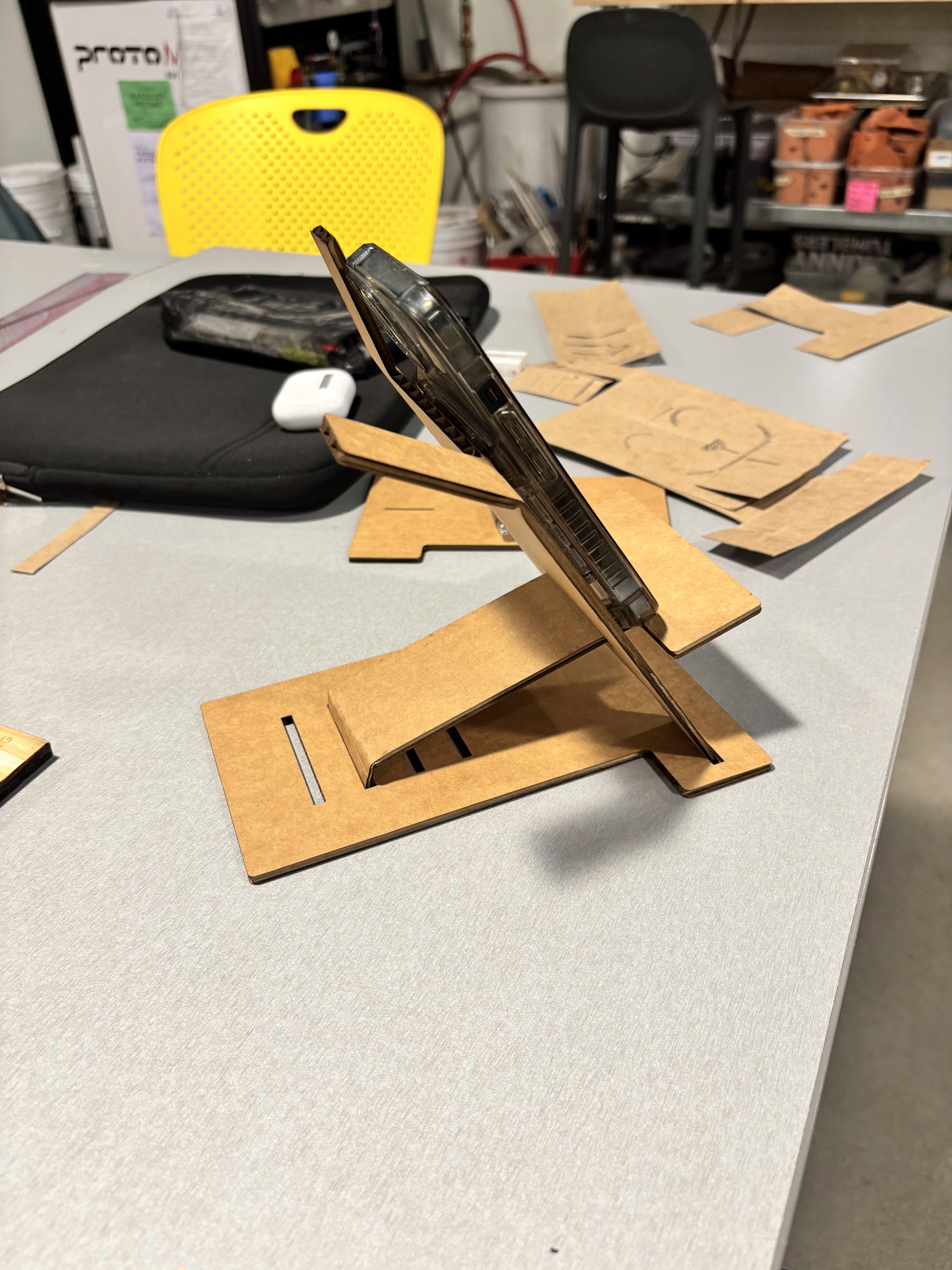
Final stand from the side, holding the phone in portrait at one of three angle settings.
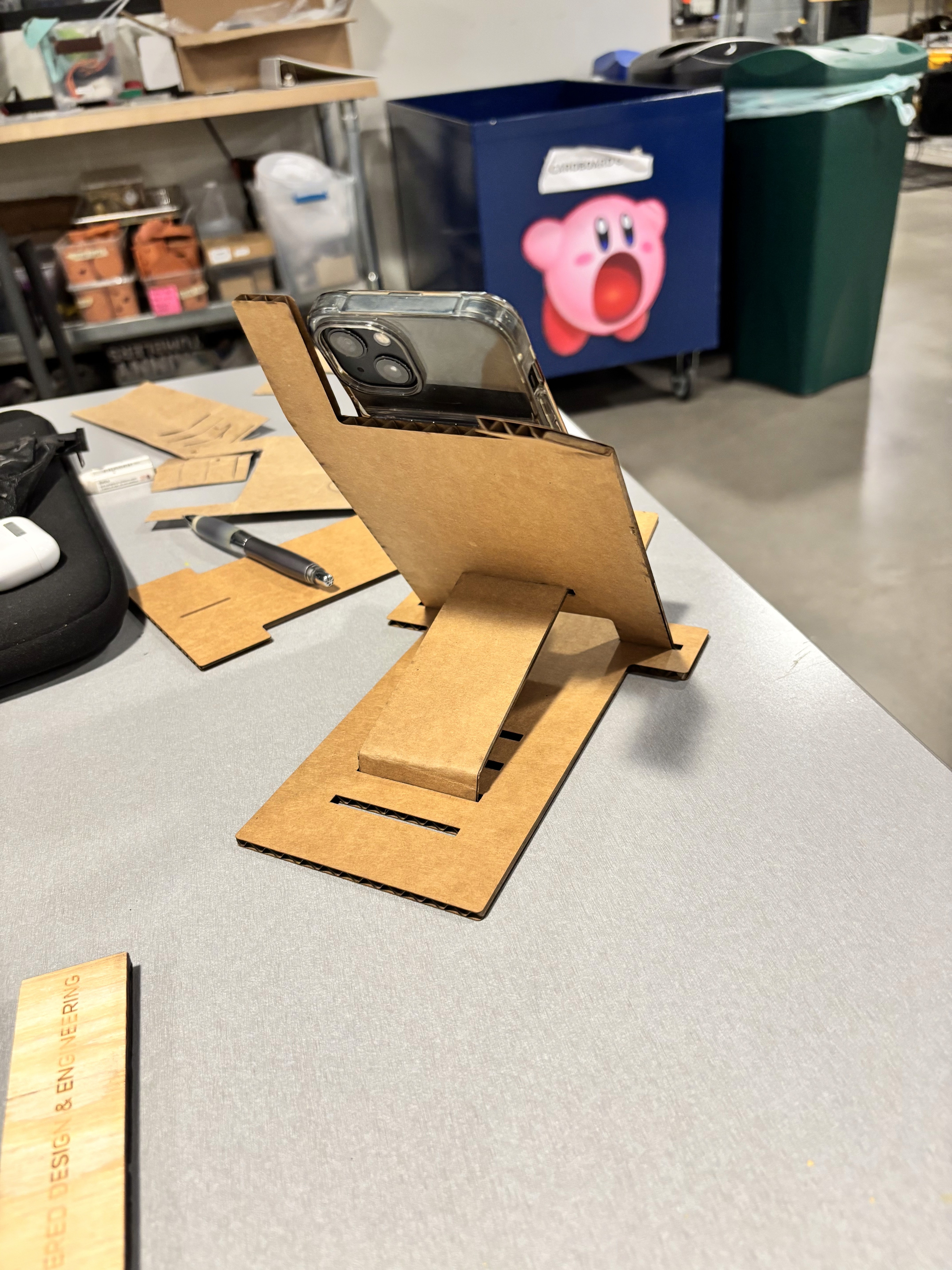
Final stand from the back. The angle adjuster sits in one of the four base slots.
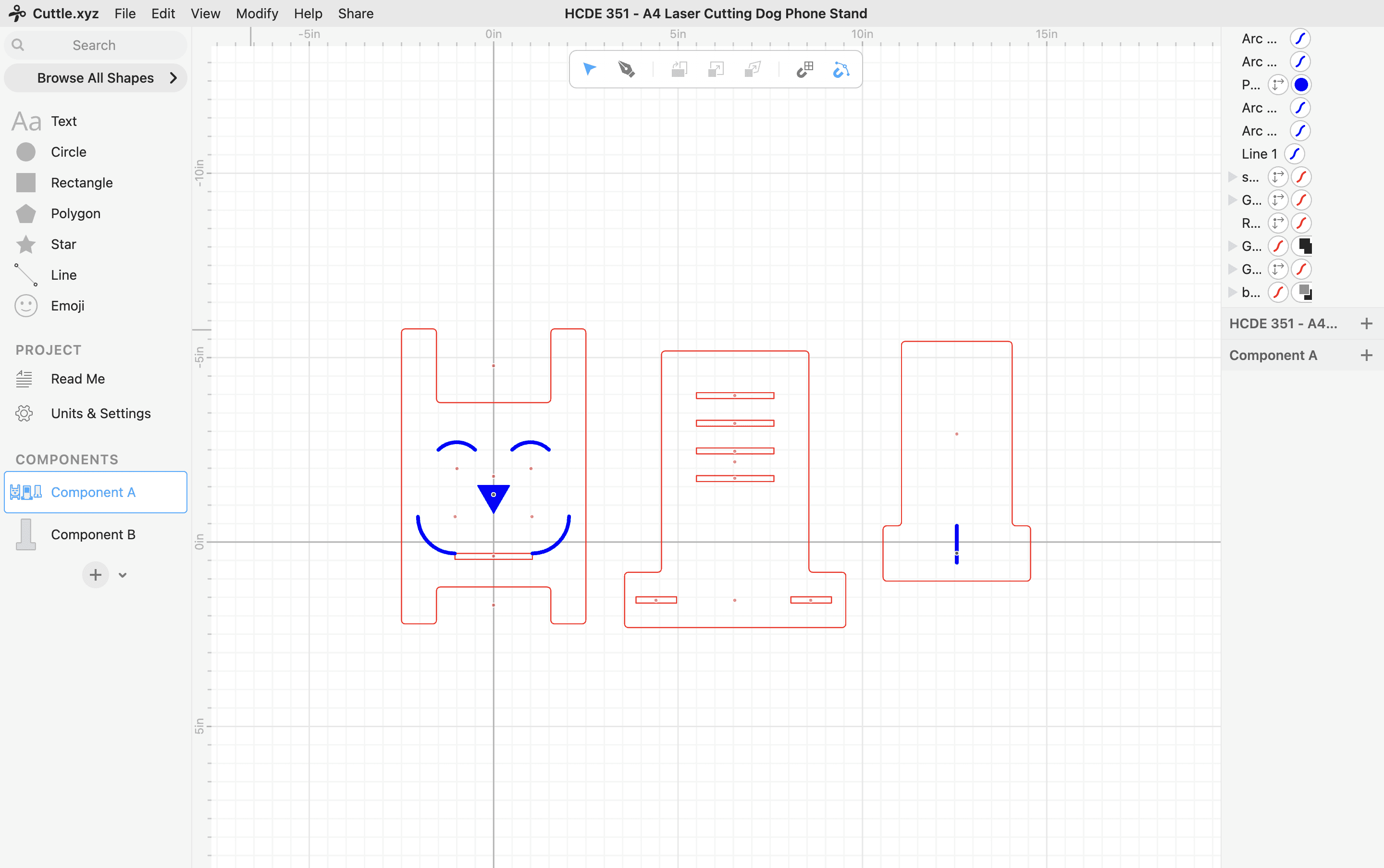
Cuttle parametric model. Backrest, base, and T-shelf laid out for the laser cutter. Dog face etched on the front of the backrest.
Once the file was ready, the laser cycle took around 10 minutes (etching the face and tongue took around 7 minutes!). The pieces came off the bed clean, joints sat snug, but not too tight after a small tolerance pass, and the etching read on the backrest.
The miscut shelf cost me one extra cycle on the laser cutter, as I had set the shelf 1 inch wider than the slot it was supposed to fit into, didn't catch it before sending the file, and only noticed once the piece came off the bed. The recut took a minute, but I learned a quick lesson to double-check dimensions in Cuttle against the actual joint widths before sending anything to the laser.
In the end, I had three pieces, with no glue or tape needed. The stand pulls apart in seconds and the components stack flat. The whole thing fits inside a notebook sleeve!
Critique
In-class prototype critique.
In class, I demoed the stand by having myself present the prototype, say nothing, hand it to peers, and listen. They assemble it without instructions, use it, and talk through their reactions while I take notes.
The following audio recording catches the moment a peer first picks the stand up. Their first comment was that the assembly was confusing on its own, but made sense once they saw it put together. The dog face etching landed well.
The strongest piece of structural feedback was about the folded angle adjuster. A peer pointed out that flute is not easy to fold, and that a slotted piece sliding into the base would feel more stable than relying on a crease. The same observation came up for the backrest support. My takeaway was to lean into slots over folds.
The other piece of feedback was a feature request of having a top-down filming angle, where the phone would point straight down at something on the desk. This is exactly the use case the assignment described, and my stand only handles forward-facing tilt rather than looking down. A future iteration would add a fourth angle that flips the phone toward the surface below, or a separate top-down attachment that lets the stand work in two filming modes.
Analysis
What worked, what didn't.
I evaluated the stand against the assignment requirements and my own three personal specs. From the assignment side, the final prototype was cut from one sheet of corrugated pad, using no glue or tape, and disassembles flat. From the personal side, it holds a 200g iPhone 15 Plus with case at three viewing angles, stands up unloaded without tipping, and has a visual element I enjoy.
The final stand met all three personal specs. It held the phone at three angles, stood unloaded without tipping, and the dog face etched in clean enough that peers picked up on it without me pointing it out. Joint tolerances on the laser cut were dialed in, so pieces slid together and held under phone weight. Disassembled, the three pieces stack flat enough to carry in a notebook sleeve.
However, there were a few notable mistakes in completing the assignment. As stated earlier, the folded angle adjuster works but feels less stable than an improved slotted equivalent would. Adjusting between the three angles requires lifting and reseating the back, which is finicky when you are in the midst of recording. The stand additionally does not cover the top-down filming angle as a primary use case, only forward tilt, and miscut shelf was an additional error.
Iterating in cardboard before flute was the right call. The base slot omission was a structural error I luckily caught in the more disposable cardboard material rather than flute. Even with that, the miscut shelf reminded me that dimension verification should happen before, not after the laser cutting. Cuttle's parametric tools helped, as I drove every slot from one width parameter, but I let the shelf width drift out that system. Next time, every cut piece will be parameterized.
For future iterations, I should improve the slotted angle adjuster instead of folding the flute. Top-down filming mode, either as a fourth angle or a separate attachment, should be added. A cable channel hole in the shelf for charging while filming and even more rounded corners on the silhouette so the dog reads even more clearly, were also a few afterthoughts I had.
AI
AI usage.
Claude used the Framer MCP to aesthetically structure the process log with images and duplicate components in the CMS.