OXO Good Grips Furlifter Pro lo-fi prototyping for an all-in-one handheld pet grooming appliance.
Role
Lo-fi Prototyping
Tools
Cardboard, duct tape, everyday objects
Outcome
A lo-fi prototype exploring modular pet grooming for OXO's Good Grips line. Sketching form concepts, building a physical model, and running user evaluation.
Goal
The prototype objective.
Create a 3D lo-fi prototype of how OXO might design an all-in-one pet brush, nail filer, and pet massager device.
Brush component that allows for all-over fur brushing.
Comb for fine-grained de-matting and/or flea removal.
Rotary tool that allows your pet's nails/claws to be filed. Must be able to be turned on and off and choose from 3 speeds.
Massager, (similar to a back massager for humans). Must be able to turn on and off and choose from 3 speeds.
Digital display allowing you to choose and play 5 different soothing sounds (ocean waves, rainfall, birds chirping, dogs howling, or cat purring).
Between 1 and 2 lbs.
Must be able to be used in either your right or left hand.
The device must be shorter than 8 inches long in the longest dimension.
The components of the device can be modular if needed.
Design Rationale
All-in-one care, designed for both hands.
OXO is known for making comfortable, intuitive, and universally accessible tools. What would it look like if OXO expanded into a new product category that pairs physical ergonomics with a digital interface?
I chose to prototype the OXO Furlifter Pro concept: a handheld, all-in-one pet grooming appliance combining a brush and comb, rotary nail filer, vibrating massager, and a digital sound display. The device needed to stay under 8 inches long, weigh between 1–2 lbs, and work in either hand.
Sketches
Designing for usability and desirability.
The primary design goal was usability, since a pet grooming device gets used with divided attention, one hand occupied, and a pet that may be moving around. Each control placement and design decision had to support that context. As such, desirability was a secondary consideration.
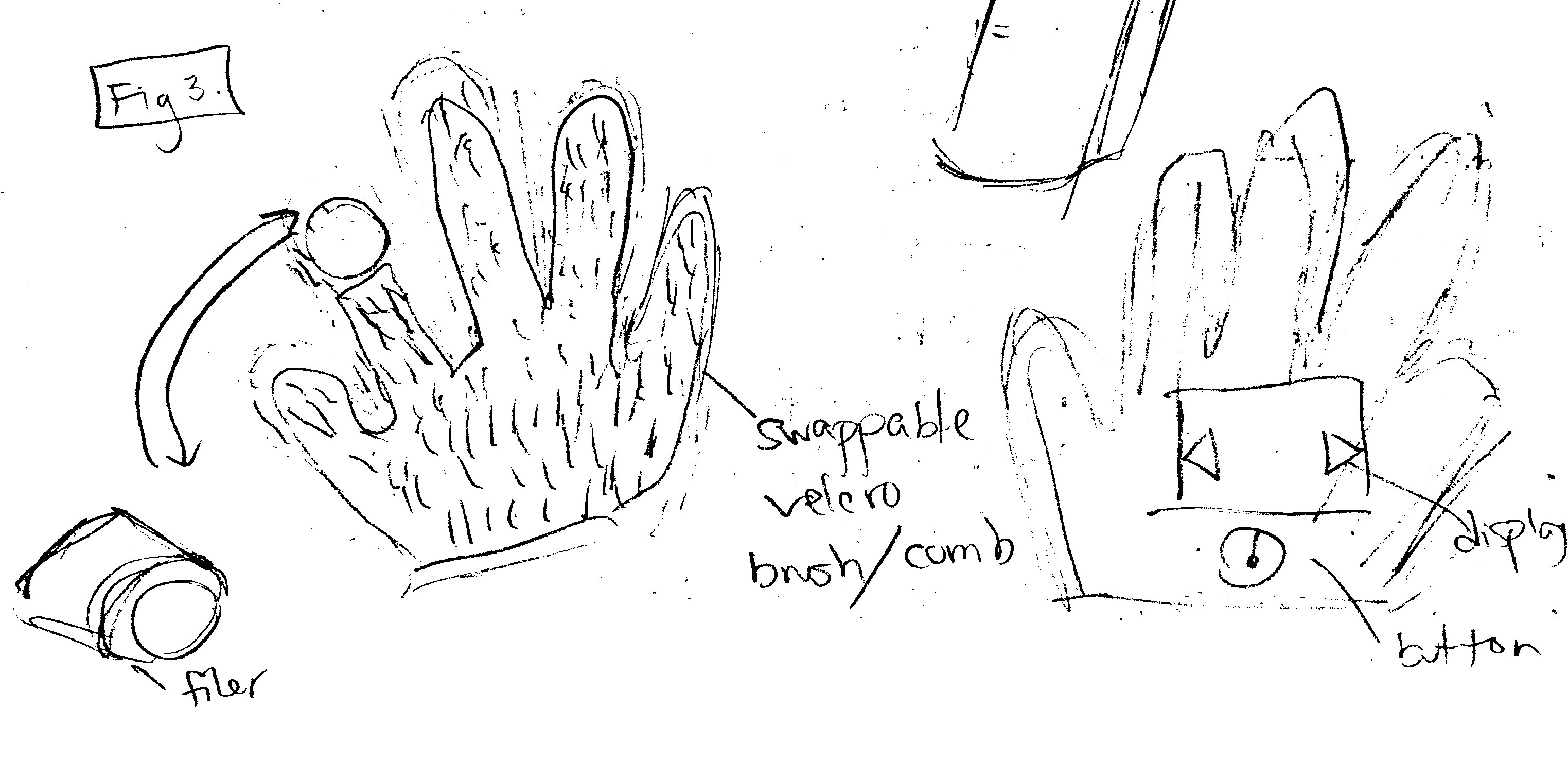
A wearable glove concept with palm brushes and a rotary filer on the pointer finger. Interesting ergonomically, but modular attachments would be difficult in a wearable form.
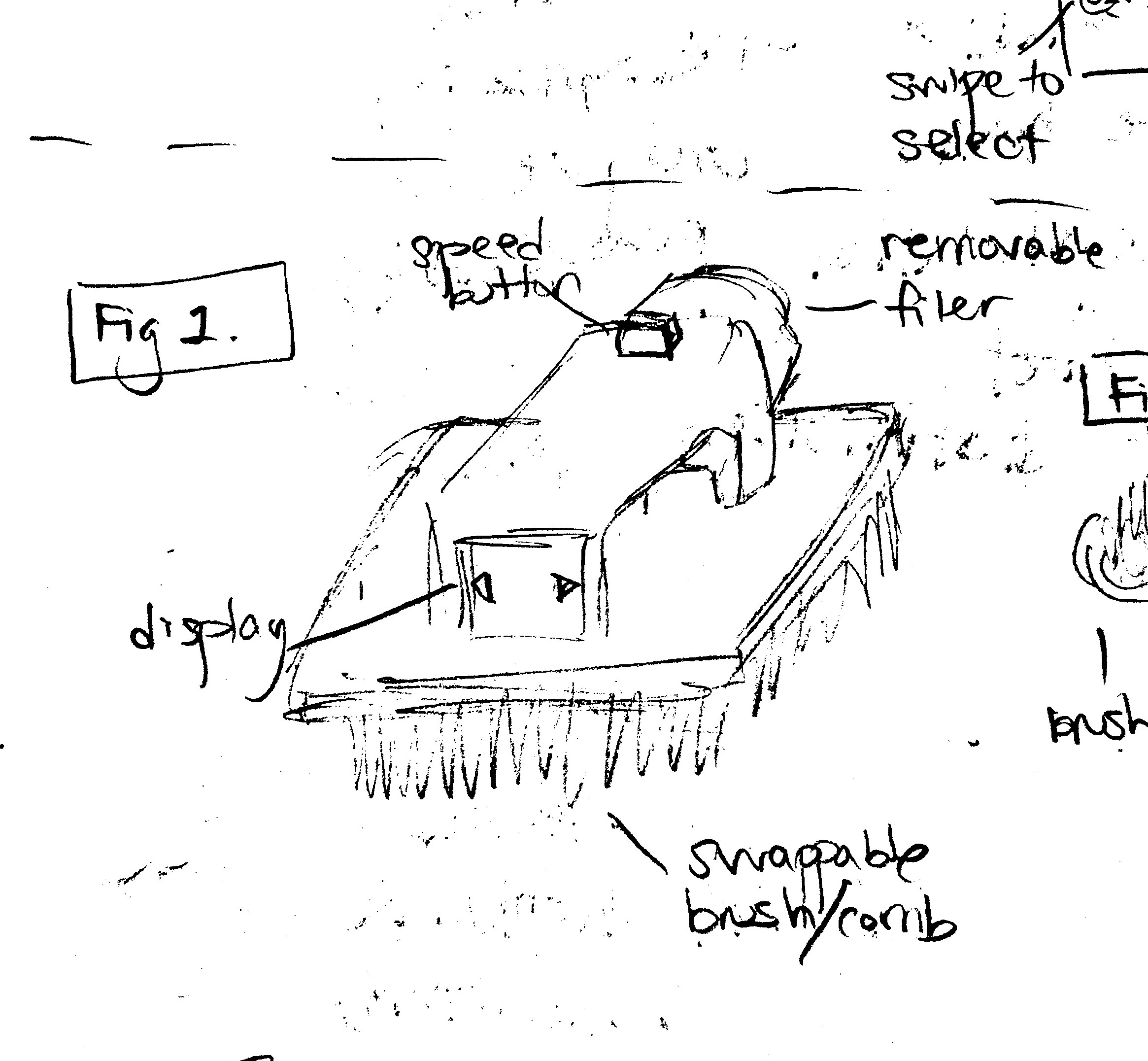
Flat and low-profile, with thin metal bristles for combing. Explored placing the digital display behind and a speed button on the spine.
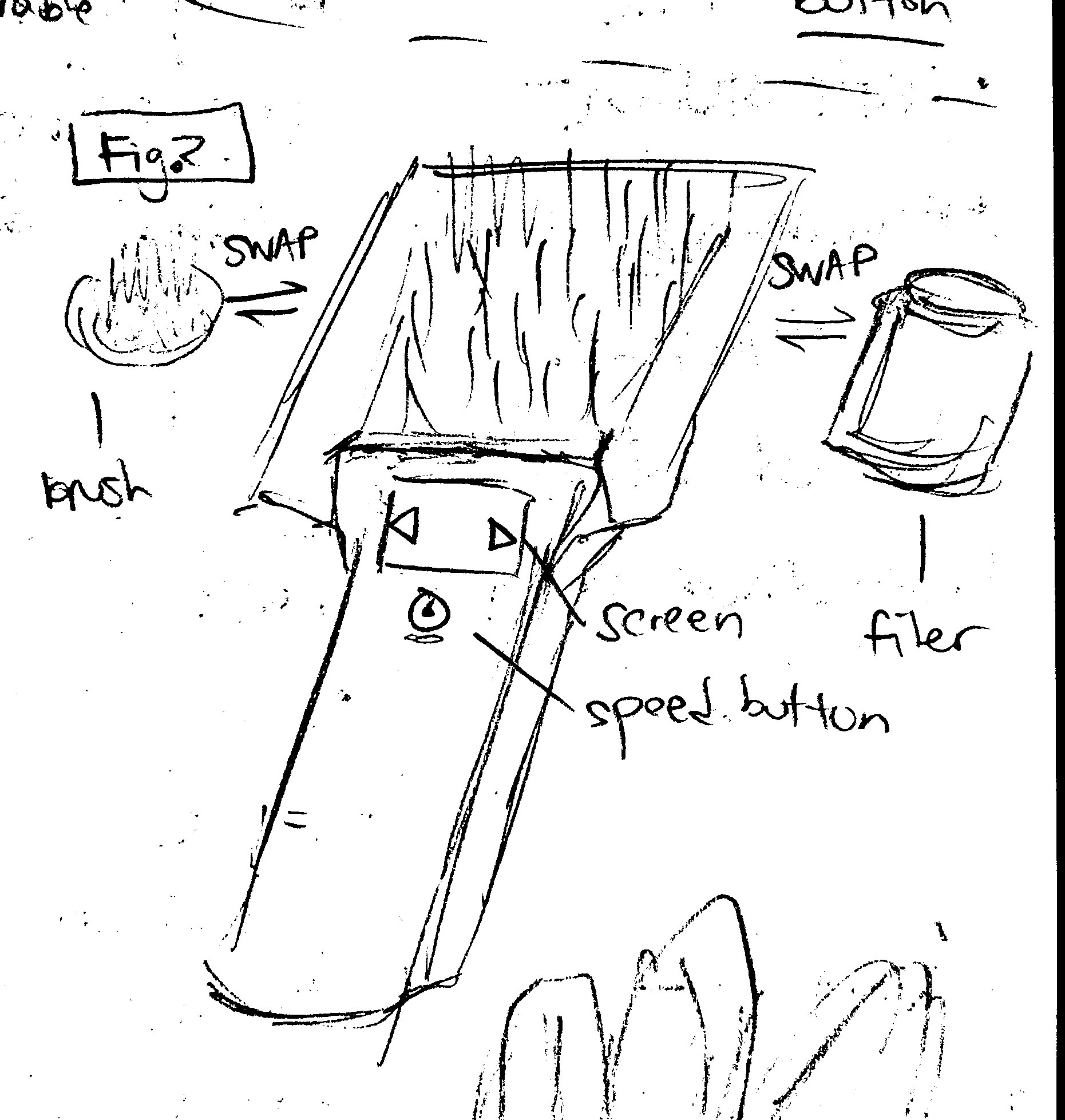
Handle with a wide grip and swappable heads. Display sits centered, with a speed button on the side of the handle. Wide grip distributes force across the palm rather than concentrating it in the fingers.
Sketch Approach
Three directions, one final prototype.
All three concepts focused on grip shape, control placement, and how the modular attachments would connect. My annotations called out key decisions of swappable brush and comb, speed button accessible to the thumb, and a display with left and right navigation arrows for sound selection.
Each product requirement shaped a specific design decision. The brush and comb attachment is modular with a push-pull mechanism. The rotary filer and vibrating massager each connect to the same port and share the speed button on the side, with 3-speed cycling controlled by repeated presses. The digital display handles sound selection through two navigation arrows, kept intentionally small as a setup control. The wide wedge grip was chosen to distribute force across the palm, supporting ambidextrous use with the button and display being detachable. The average weight with different attachments came in around 1.1 lbs, within the 1–2 lb target, and the assembled length stayed under 8 inches.
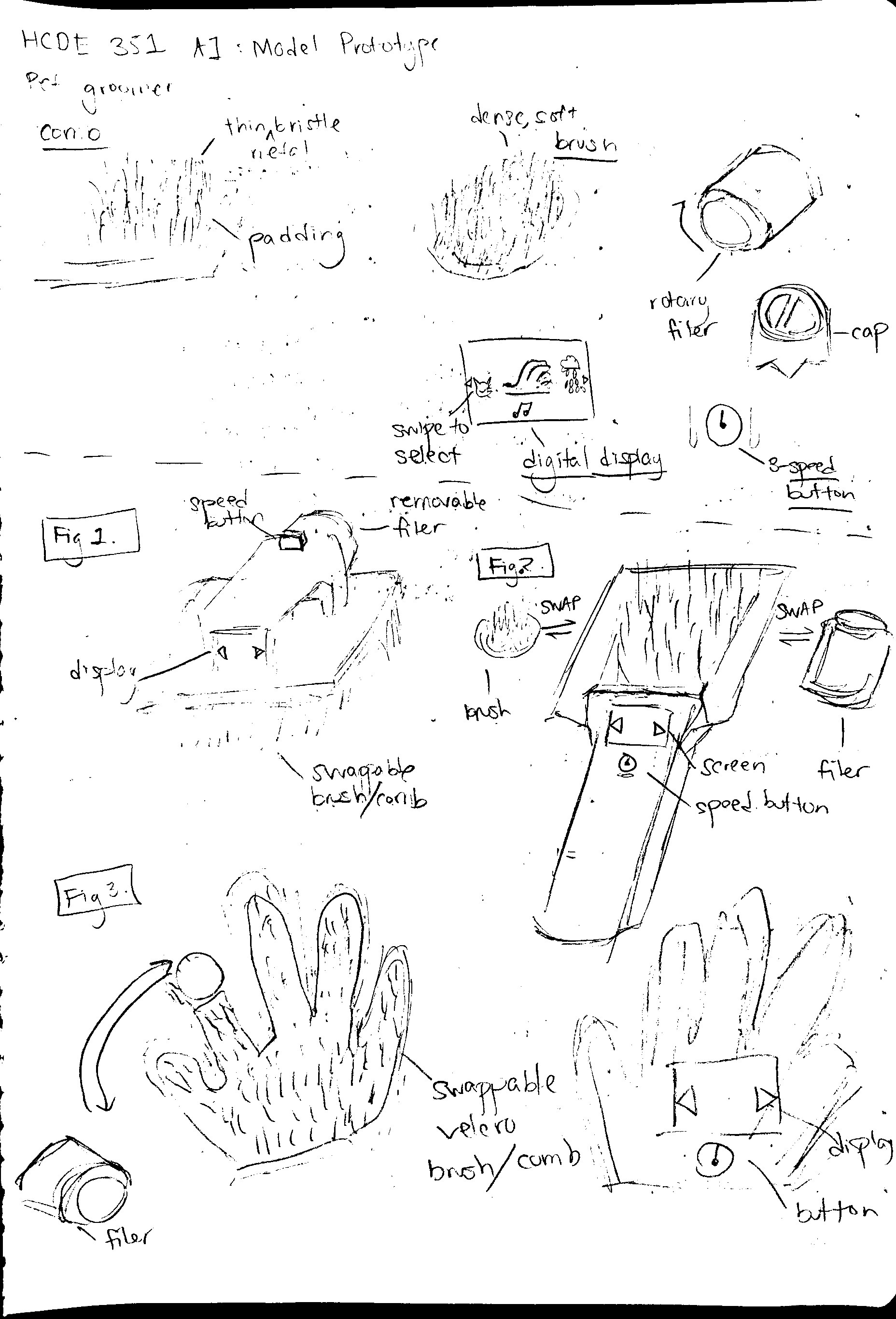
Full sketch with figures 1, 2, and 3 and annotations. Excuse the lack of clarity, I used the black and white filter for scanning...
The last prototype with a wide grip was selected because the wedge shape naturally positions the thumb over the controls. The attachment swap mechanism was sketched on the front face of the handle, keeping the grooming head centered and predictable across brush, comb, filer, and massager (forgot in sketch, but is modular too!) configurations.
I also sketched the digital display including two arrow buttons for changing sound options, a music icon, and the selected sound name and icon. Keeping the display small was a deliberate choice, as the screen is a secondary control used during setup.
Prototype
Assembled from whatever was around.
The prototype was built entirely from everyday objects chosen for their ergonomic properties and control placement. The goal was to reach the 1–2 lb. weight range and use my best ability to approximate the wedge-grip form.
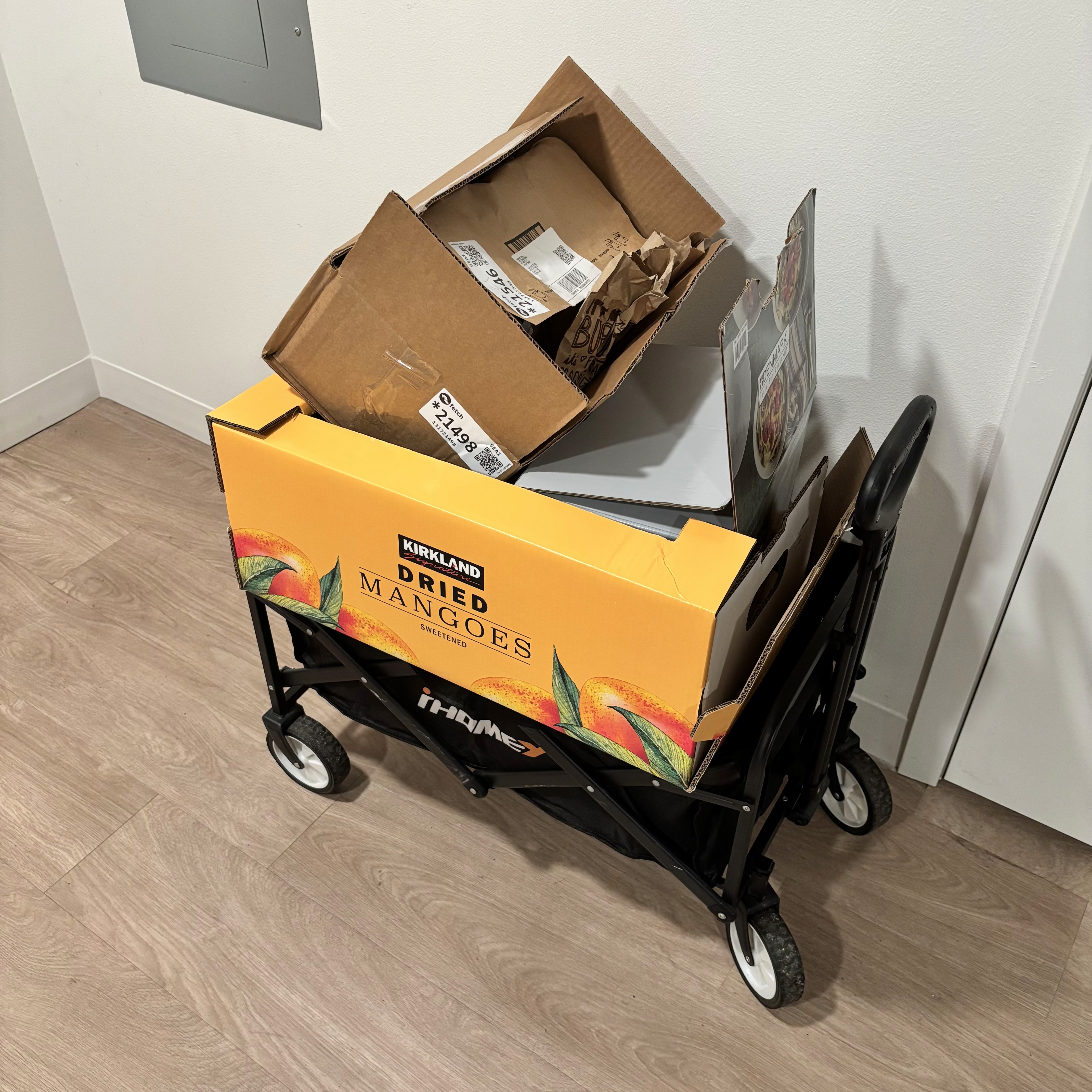
Cardboard for body and buttons.
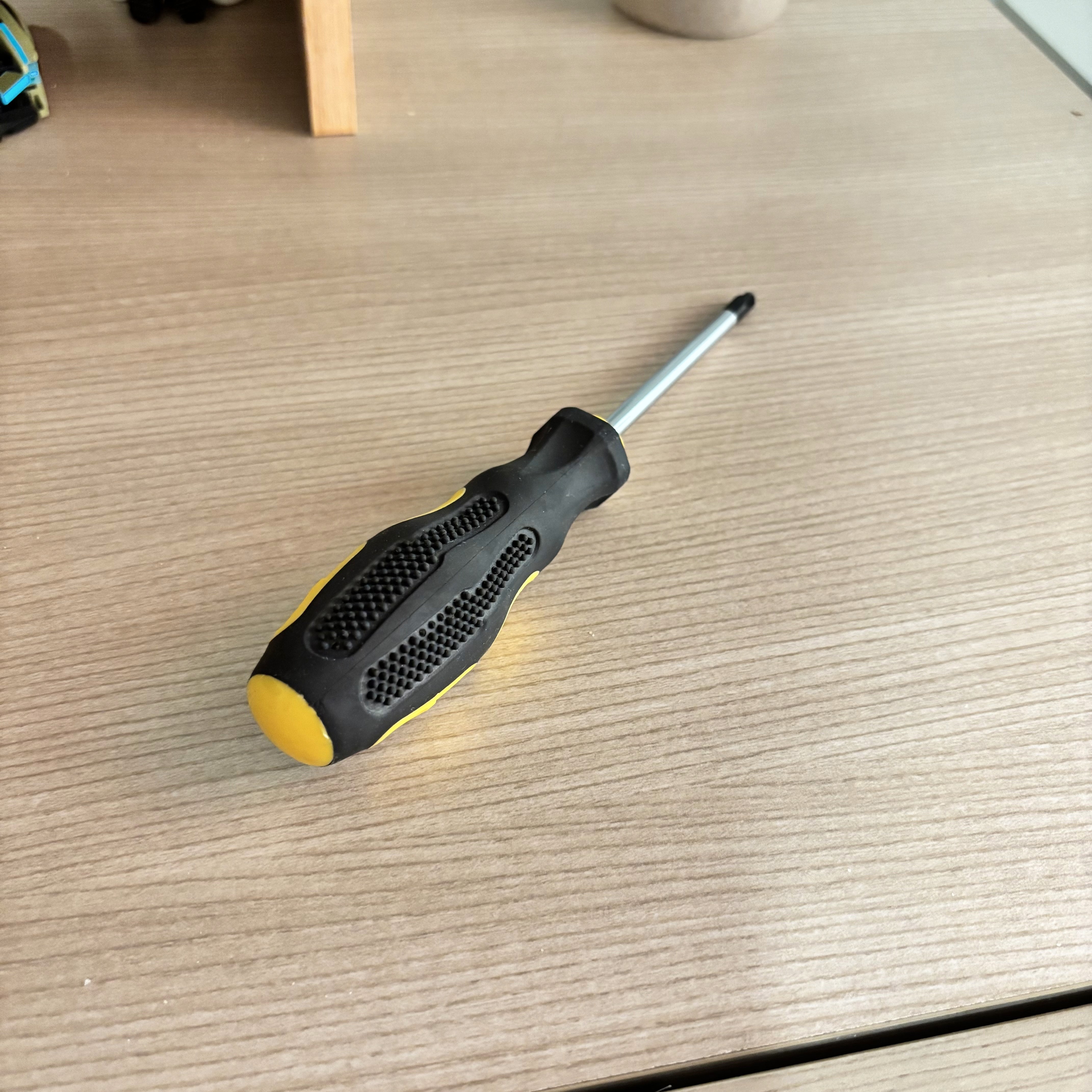
Screwdriver as rotary filer.
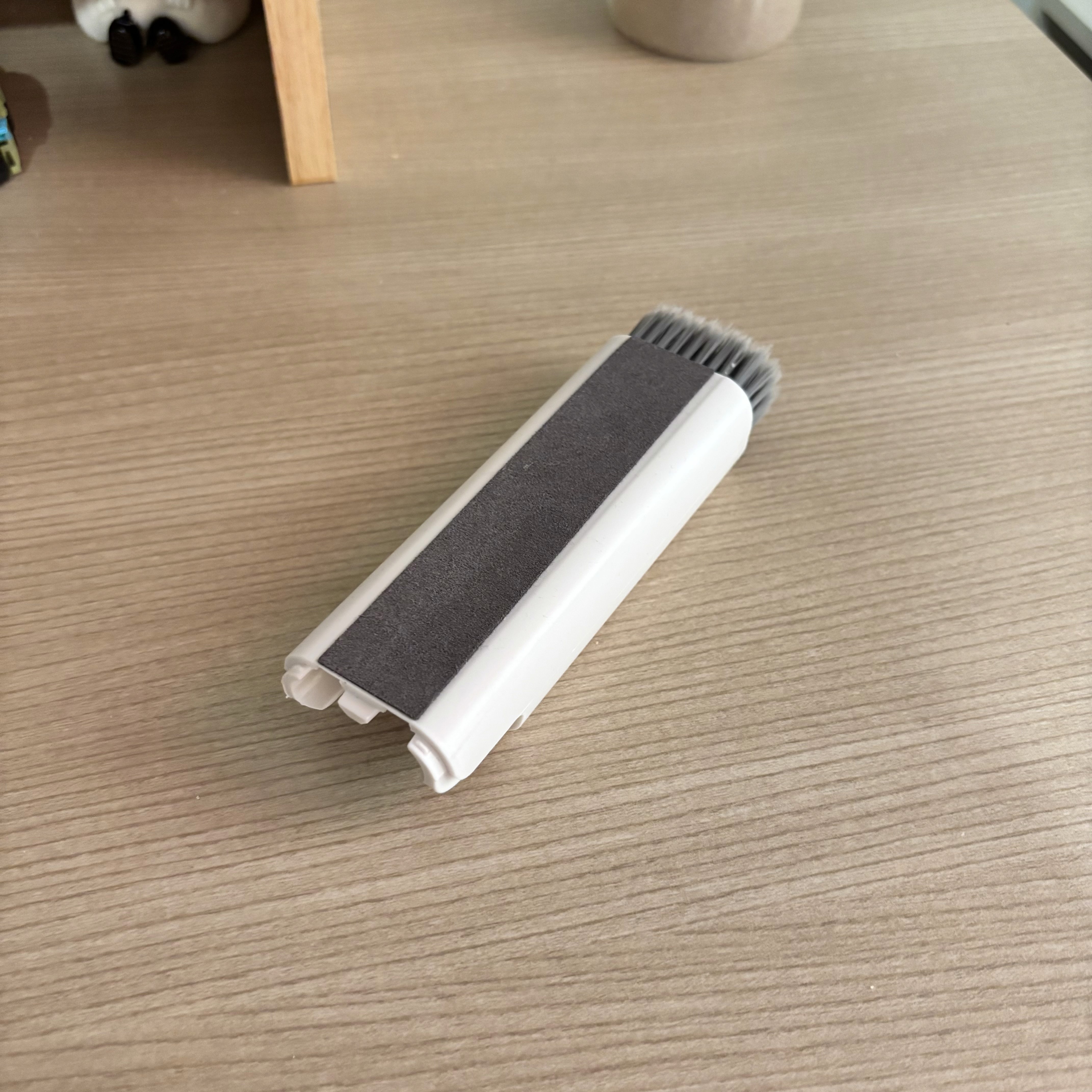
Keyboard brush for comb head.
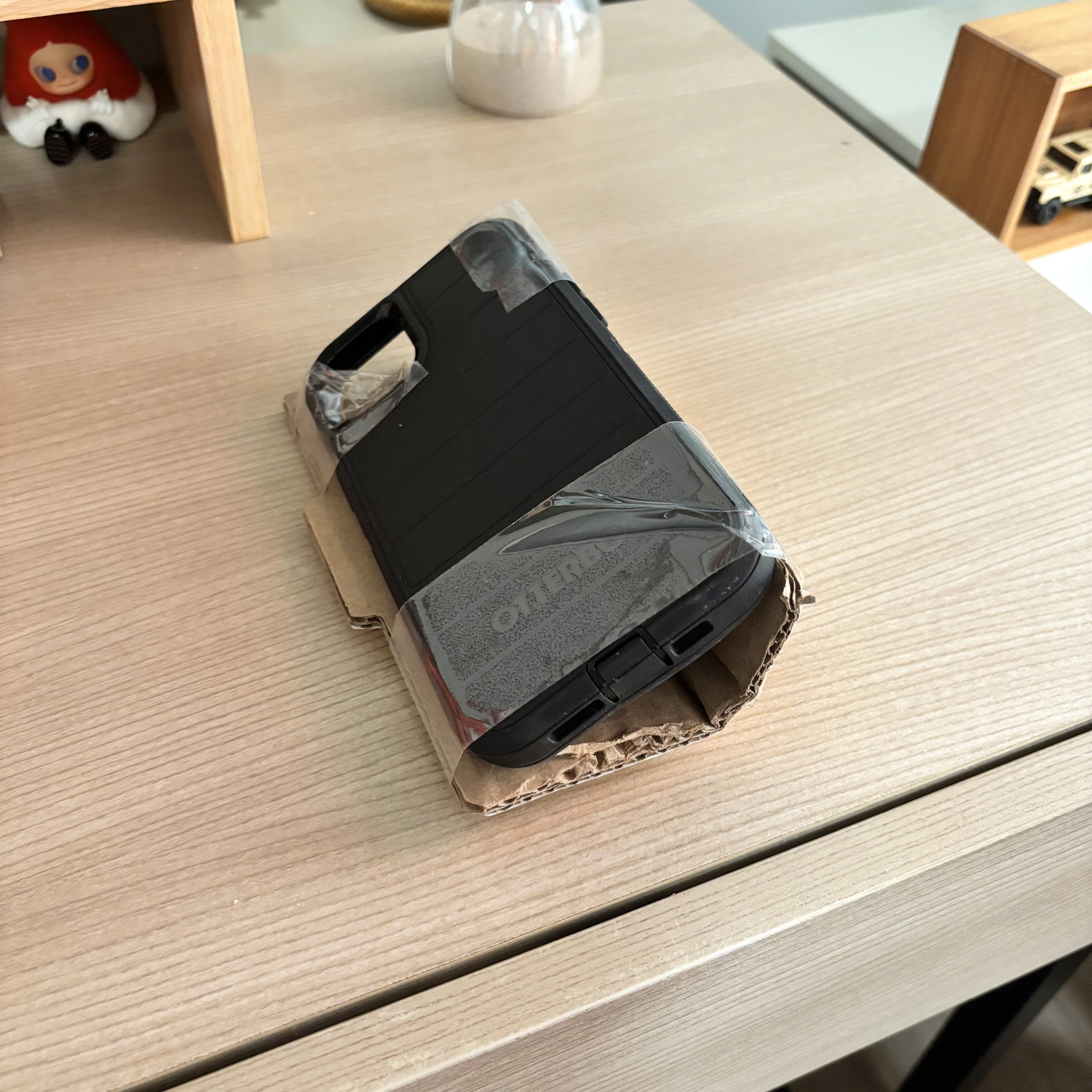
Otterbox phone case for grip texture reference.
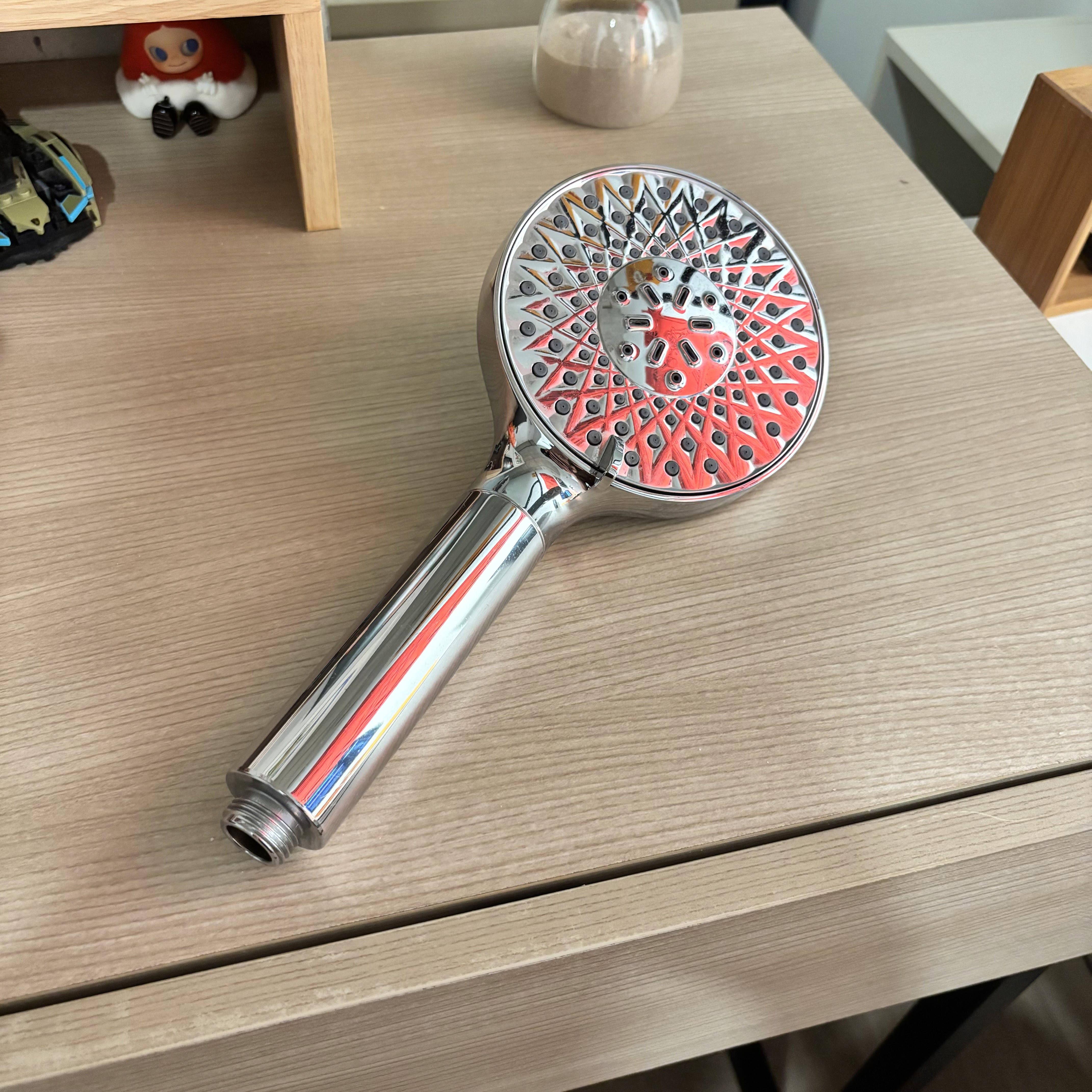
Shower head for brush size reference.
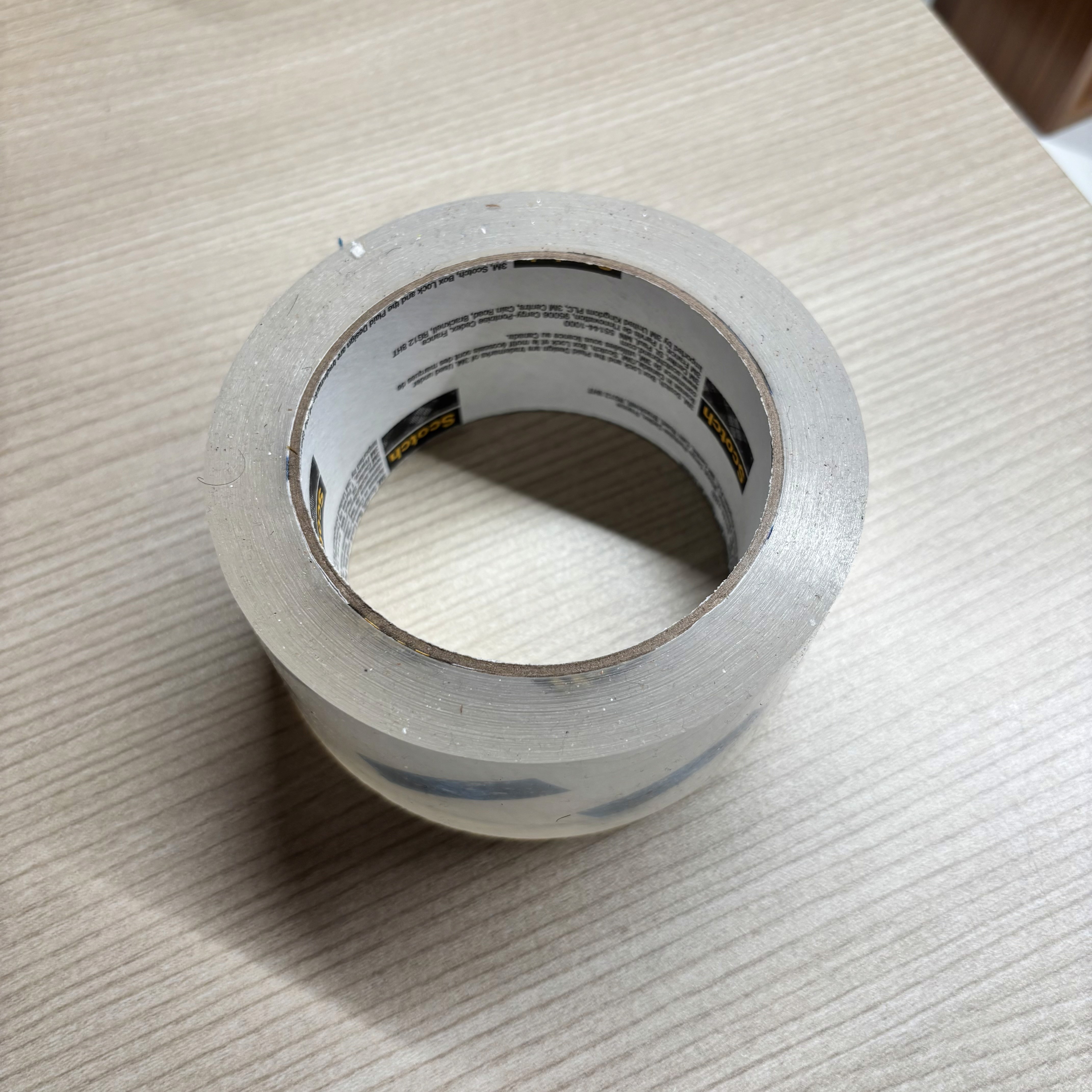
Tape to secured components and indicate seams.
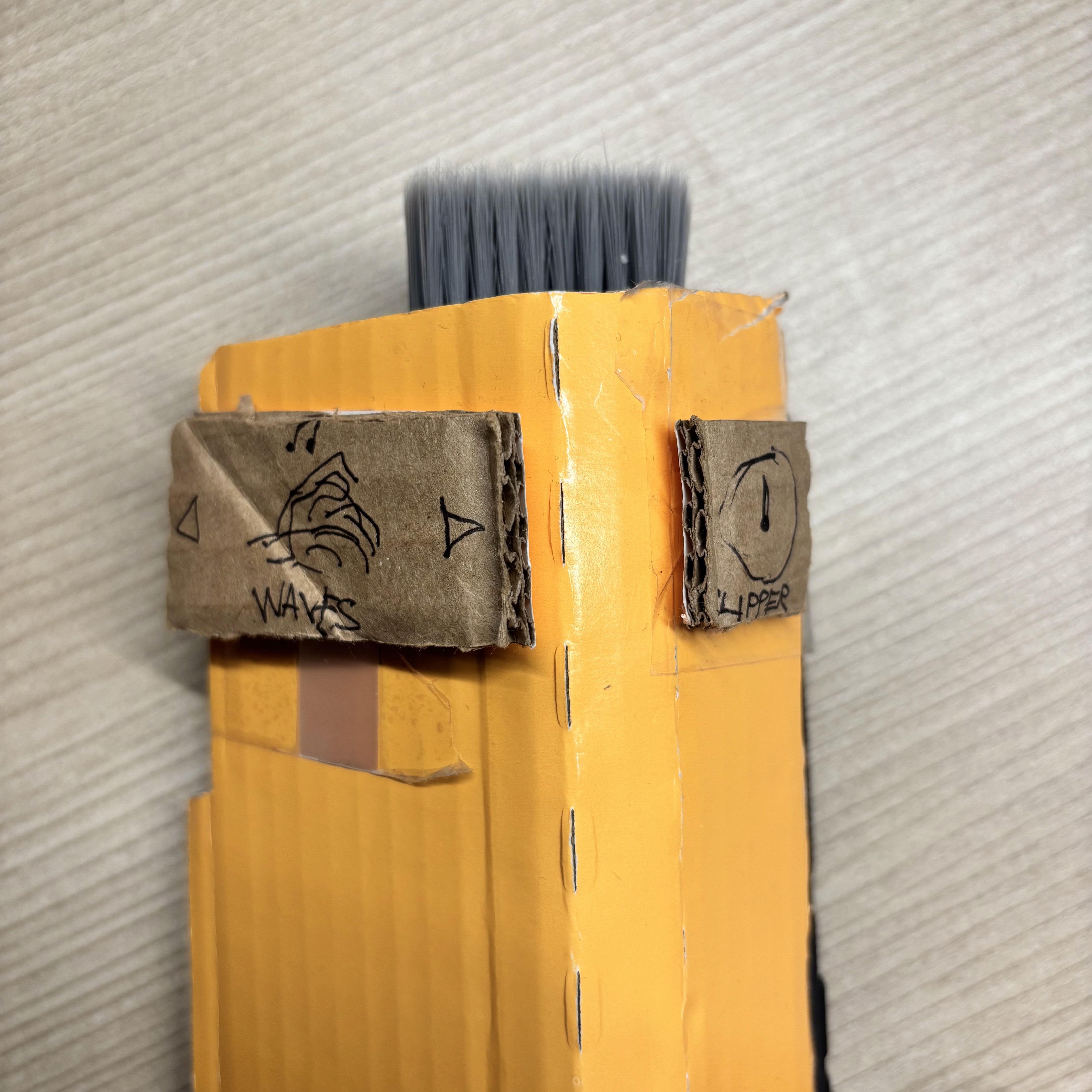
Digital display and speed selector cardboard buttons.
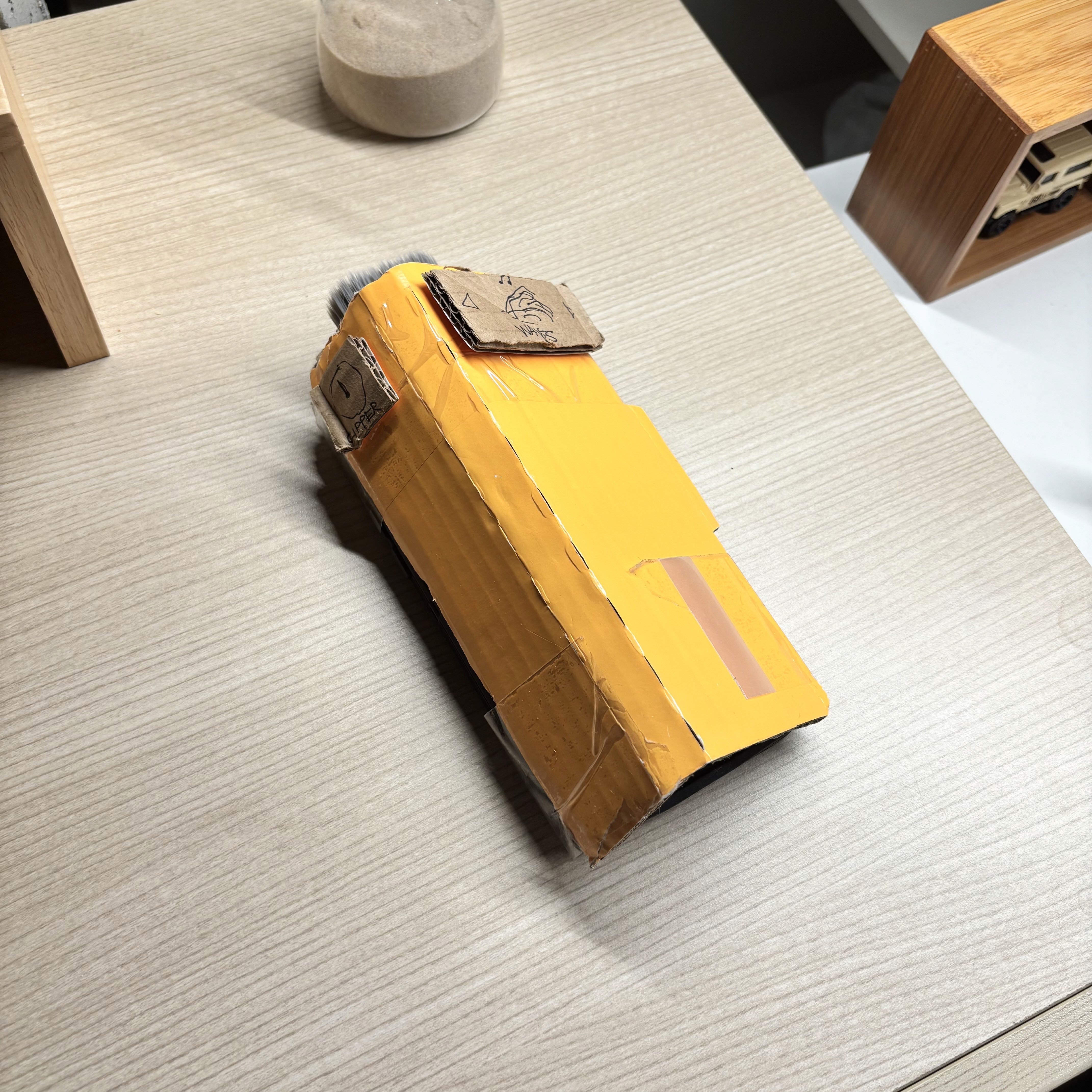
Assembled prototype here with front face showing.
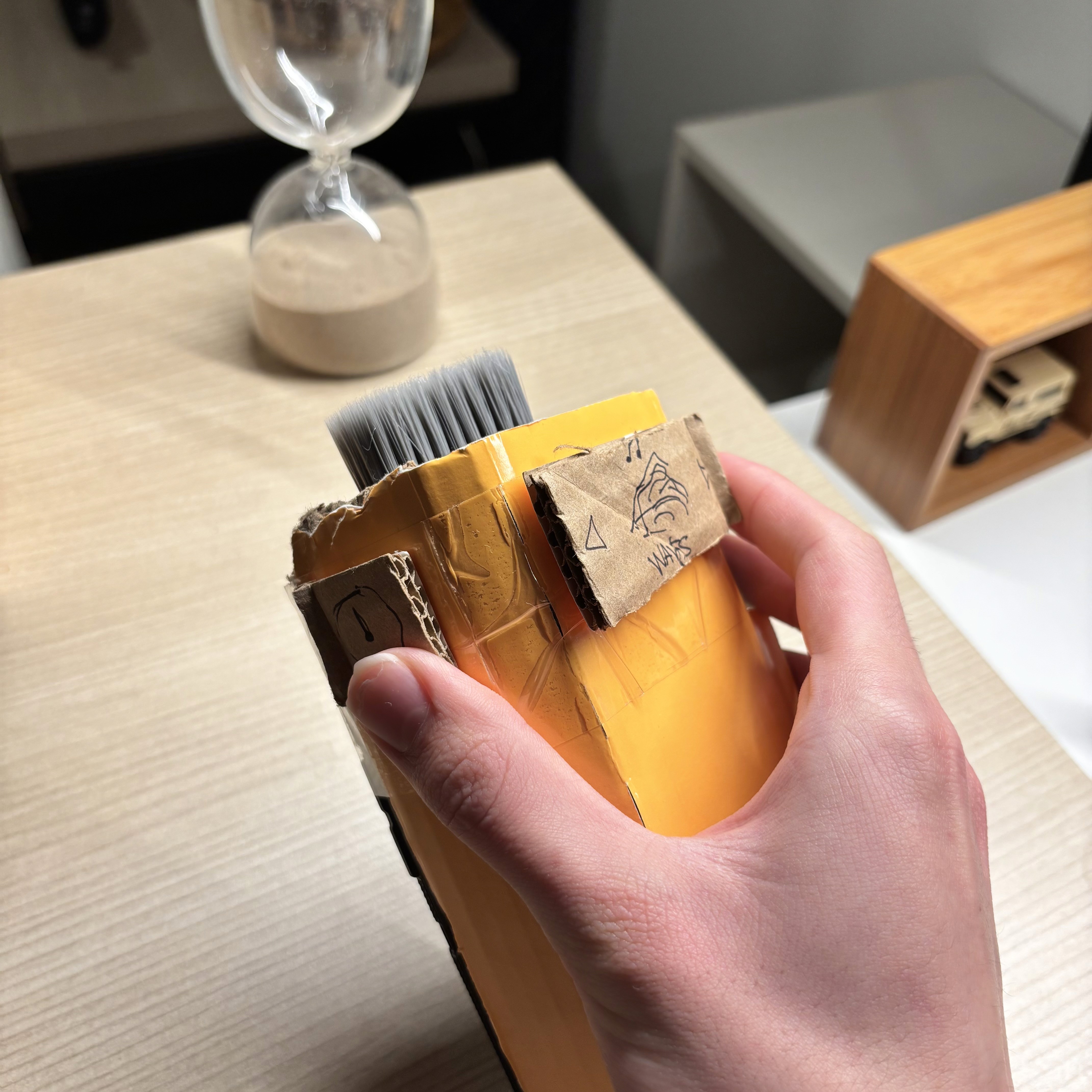
Grip-friendly wide right hand grip.
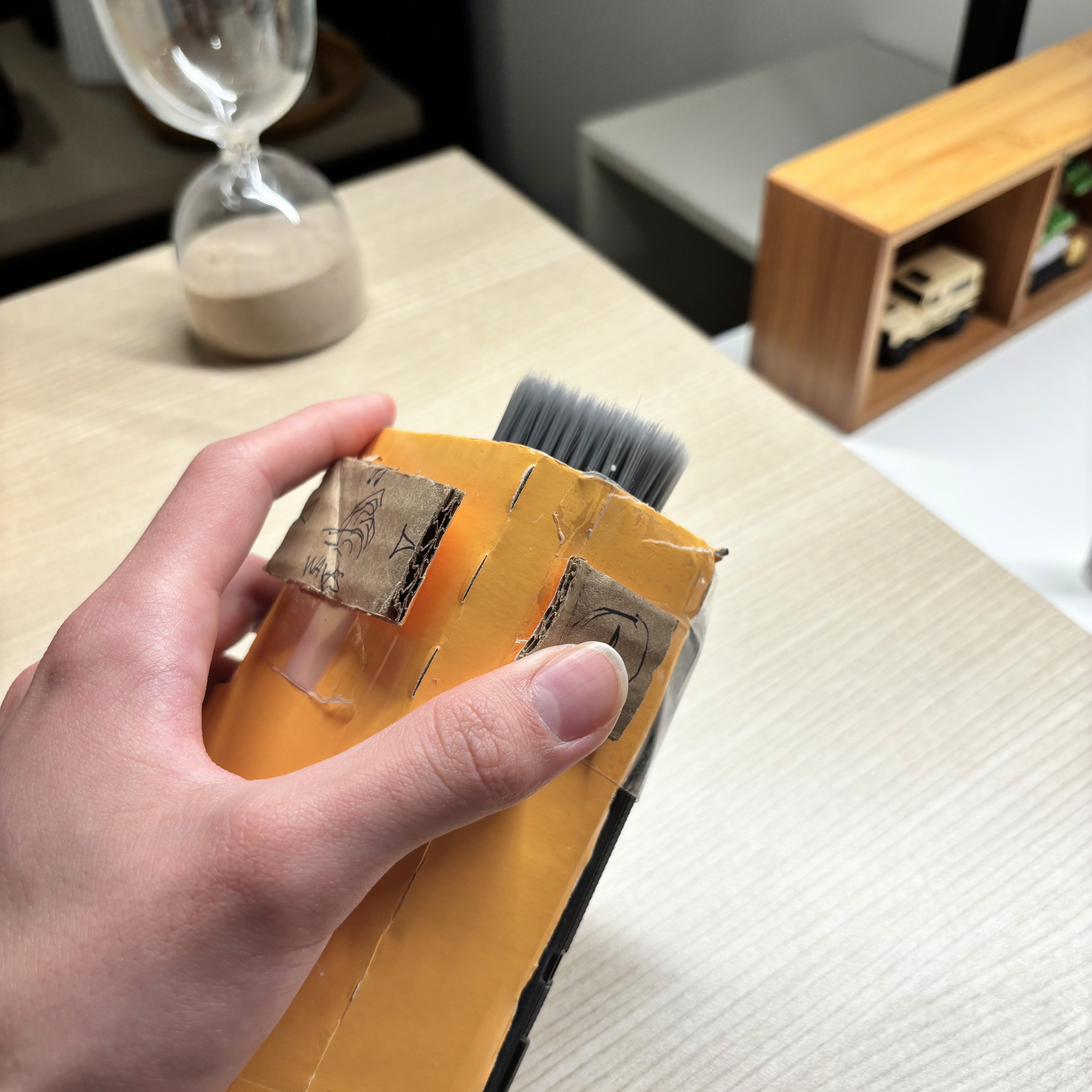
Modular buttons and reversibility for left hand grip!
The screwdriver was a stand-in for the rotary filer, with a diameter close to the real thing. The keyboard brush slotted into the front face as the comb head stand-in. The phone case wrapped around the handle to approximate a soft-grip surface for the fingers. The shower head was used as a length reference for the brush head.
Cardboard was cut to shape the wedge body and taped into place. Buttons features were drawn on with pen and built with small cardboard squares. The attachment seam was indicated with a strip of tape across the device, and the digital display was represented by a rectangular piece of cardboard and drawn arrows. The average assembled prototype with different attachments came in around 1.1 lbs.
Each attachment head was distinct enough to identify by feel. The brush and comb sat at the front, the rotary filer had a circular form, and the massager attachment had a recognizable shape (which would be a lint roller). The swap mechanism used a push-and-pull click (indicated by the brown strip) to operate one-handed without looking down.
User Evaluation
Testing and scenarios with no intervention.
The user evaluation used a scenario-based format, where the tester was handed the prototype and given a scenario: "Your cat's gone a couple weeks without grooming, so you'd like to comb her mats, switch to file her nails, then brush her loose fur."
The videos below are a short clips from the user evaluation session. It shows the tester receiving the scenario, handling the prototype, swapping between attachments, and navigating the display. No instructions were given on how to use the device.
If the video above isn't playing, click here to open it in Google Drive!
The second video shows the first take, where the loose keyboard brush component was removed instead of the entire brush handle. The fit of the components were quite tight and the objects did not have the same size. Below is an audio recording of the feedback I received after user testing.
The tester engaged naturally with the controls without prompting. They located the speed button by thumb on first pass and used the navigation arrows on the display to cycle through sounds before setting down the prototype. They first questioned the wide grip, considering the disadvantages of individuals with smaller hands, and noted that holding the device for an extended brushing session might feel fatiguing.
The tester also paused on switching between the comb, brush, and rotary filer, wondering aloud whether a single dial could cycle between the two motor modes instead of treating them as separate speed buttons. That was the strongest piece of design feedback from the session.
Analysis
What worked, what didn't.
The evaluation tested for usability and desirability, where usability was assessed through observation if the tester could find and operate the controls without instruction. Desirability was assessed through their reaction to holding and handling the device.
On usability, the prototype performed well. The user naturally located the speed button by thumb, used the navigation arrows on the display to cycle through sounds, and easily swapped attachments. The distinct shape of each head was enough differentiation to identify by feel.
On desirability, the results were mixed. The tester positively commented on the familiar modularity and to display. The grip shape, however, was the first thing they pushed back on. The wide handle is a liability for users with smaller hands, particularly for precision tasks like nail filing where more delicate control is needed.
The strongest unprompted feedback was about motor control consolidation. When the tester tried to mentally switch from the brush to the rotary filer, they paused and wondered whether a single dial could cycle through motor modes rather than requiring two separate speed buttons. Their intuition was sound, capturing the cognitive load of switching between vibration and rotation and adjusting intensity, with a single control doing both.
The prototype was effective at its primary job, communicating form, control placement, grip feel, and interaction logic for a first-time user. Both changes are form-level: a narrower grip taper near the front, and a clearer unified button or dial replacing two separate buttons.