A 3D printed backseat cupholder for the 2024 Hyundai Elantra SEL.
Role
3D Printed Prototype
Tools
PLA, Onshape
Outcome
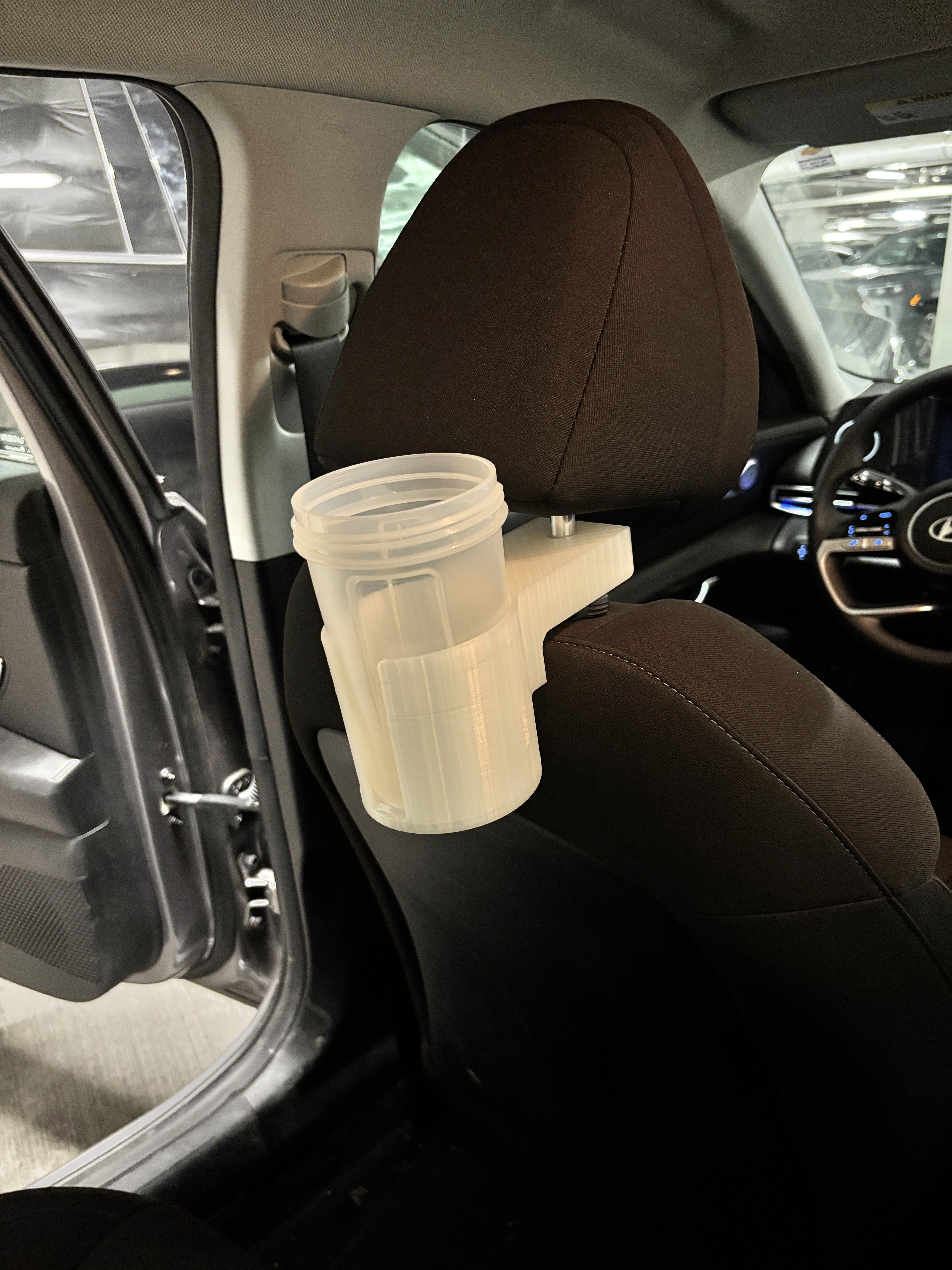
A cupholder that mounts to a single front headrest rod, giving rear passengers in the 2024 Hyundai Elantra SEL a place to set a drink. Modeled in Onshape and printed once in natural PLA.
Assignment objective.
The purpose of this assignment is to use 3D modeling and printing as a medium-fidelity prototyping technique for testing design assumptions and reducing risk, particularly where dimensions, fit, structure, or physical interaction matter. You will practice making deliberate decisions about when increased fidelity is warranted, and how physical prototypes can generate evidence that lower-fidelity methods cannot.
Create a model of an object to print in polylactic acid filament (PLA). You have a choice of what to model. Create the model, convert it to an .stl file, and get it printed. Keep the size and resolution reasonable - there are many of you who have to get access to the machines, which are not the speediest of rendering devices. Remember, this is just a prototype.
For this assignment, you should design something that would be useful in your everyday life - it must serve some function rather than just being art or for decoration. Choose an object where dimensional accuracy, physical fit, or structural behavior is central to whether the design works. Your goal is not novelty, but to select a design where 3D printing meaningfully helps you evaluate a risk or assumption that would be difficult to assess using paper, cardboard, or 2½D fabrication alone. You could even design something that would build upon and improve your soft construction or your laser cut prototype.
You will be evaluated not only on the printed object, but on your ability to justify your prototyping decisions, including the choice to use 3D printing, the level of detail in your model, and how evidence from testing informed iteration.
My Elantra's back seat has no cupholders.
The 2024 Hyundai Elantra SEL has a center console for the front seats, but rear passengers have no cupholder. On a drive where someone picks up a drink after a fast food run, they end up awkwardly cradling it or setting it on the floor. I wanted something that mounts to the car's existing hardware and requires no modification.
Three risks drove the prototype decisions.
Fit: the base plate hole must clear the headrest rod (measured at 15–16mm) while staying snug enough to prevent sway.
Stability: a filled cup must not tip under normal cornering, tested by driving with water in the holder.
Load: the 6mm fillet at the support junction holds a full drink without cracking.
Sketches
Sketch assumptions on paper before designing in Onshape.
The sketch page doubled as a design constraints document. I wrote out the risks alongside the key dimensions from the car and the mounting approach before touching Onshape. Having those on paper meant the modeling session was executing accurate measurements.
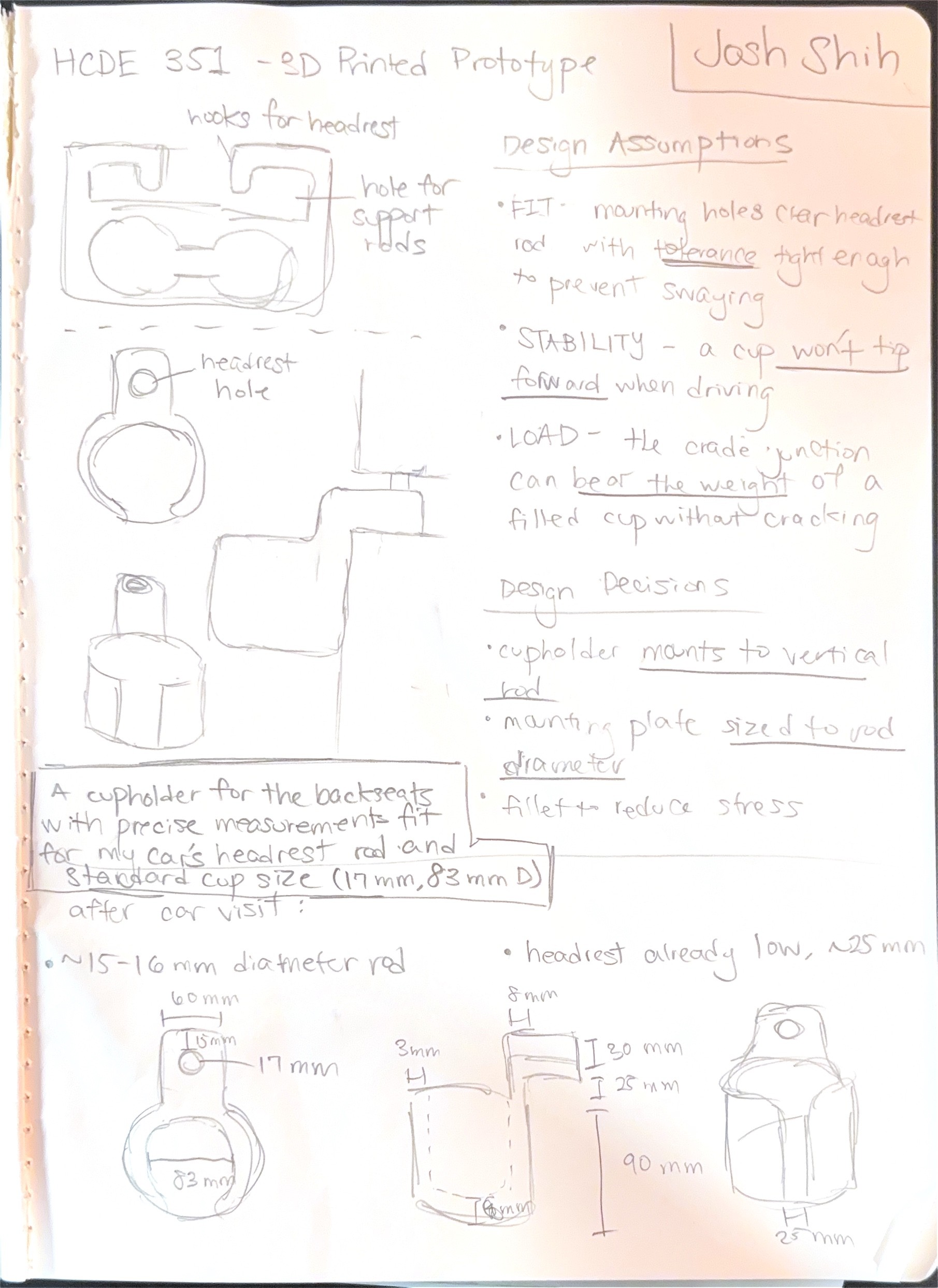
The sketch page. Design assumptions (fit, stability, load), design decisions, and measured dimensions from the car. Rod at 15–16mm; cup inner diameter set at 83mm.
1st Prototype
The cardboard told me more than I expected.
Before touching Onshape, I grabbed a cardboard box and tape. Corrugated strip became the vertical support and was rolled into a rough cylinder for the cradle. A pencil circle marked the rod hole. The whole thing took about 15 minutes.
The big find was when I held the mockup up against the headrest in my car, the cup landed right at a natural reach height for a back seat passenger. I had been planning a much longer arm to dangle behind the seat back. The cardboard prototype in the car showed that the headrest was already low enough. I measured the reduced arm length before moving to Onshape.
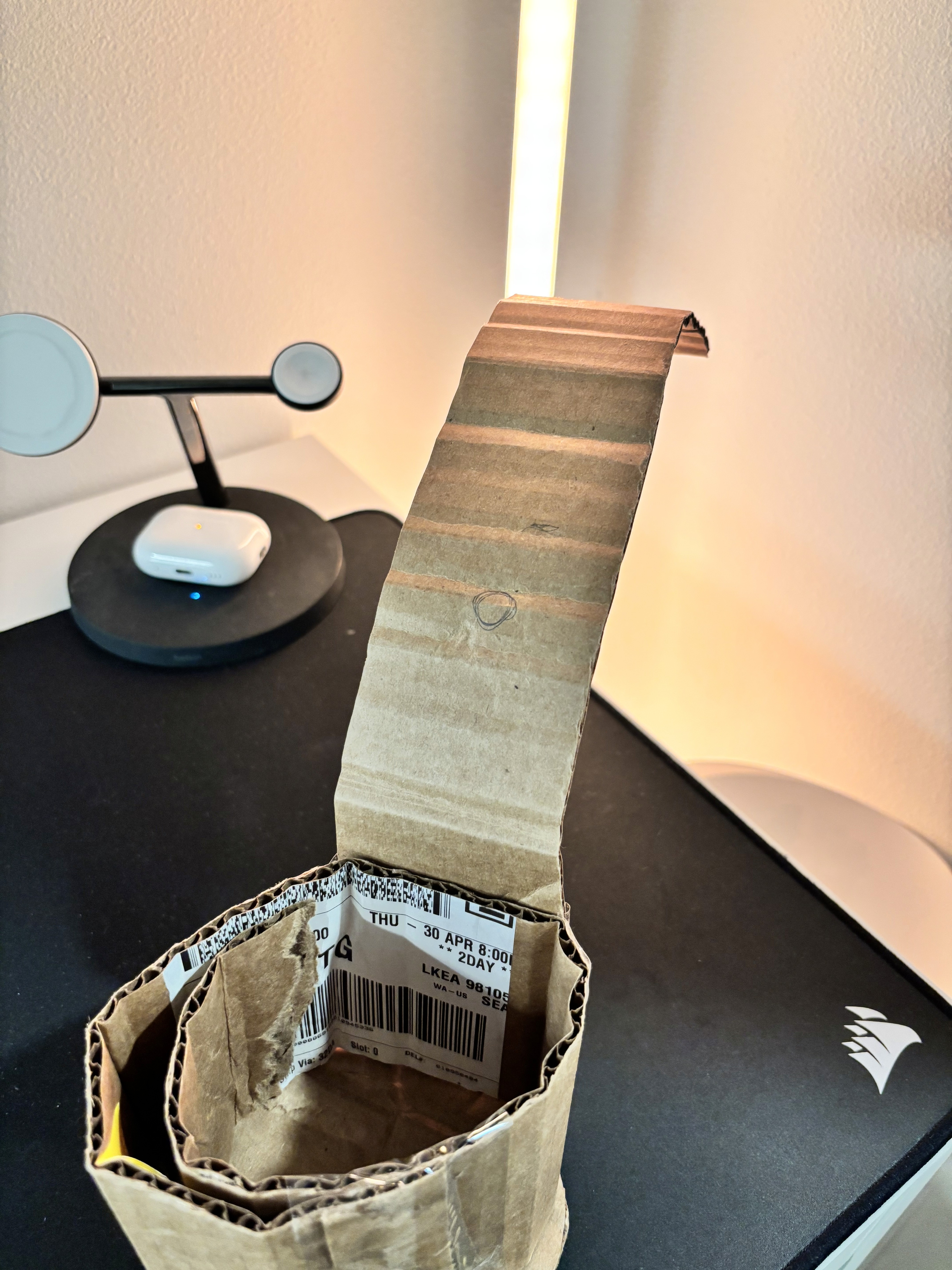
The cardboard mockup on my desk. Corrugated strip as vertical support and rolled as the cradle. Built in about 15 minutes before any modeling.
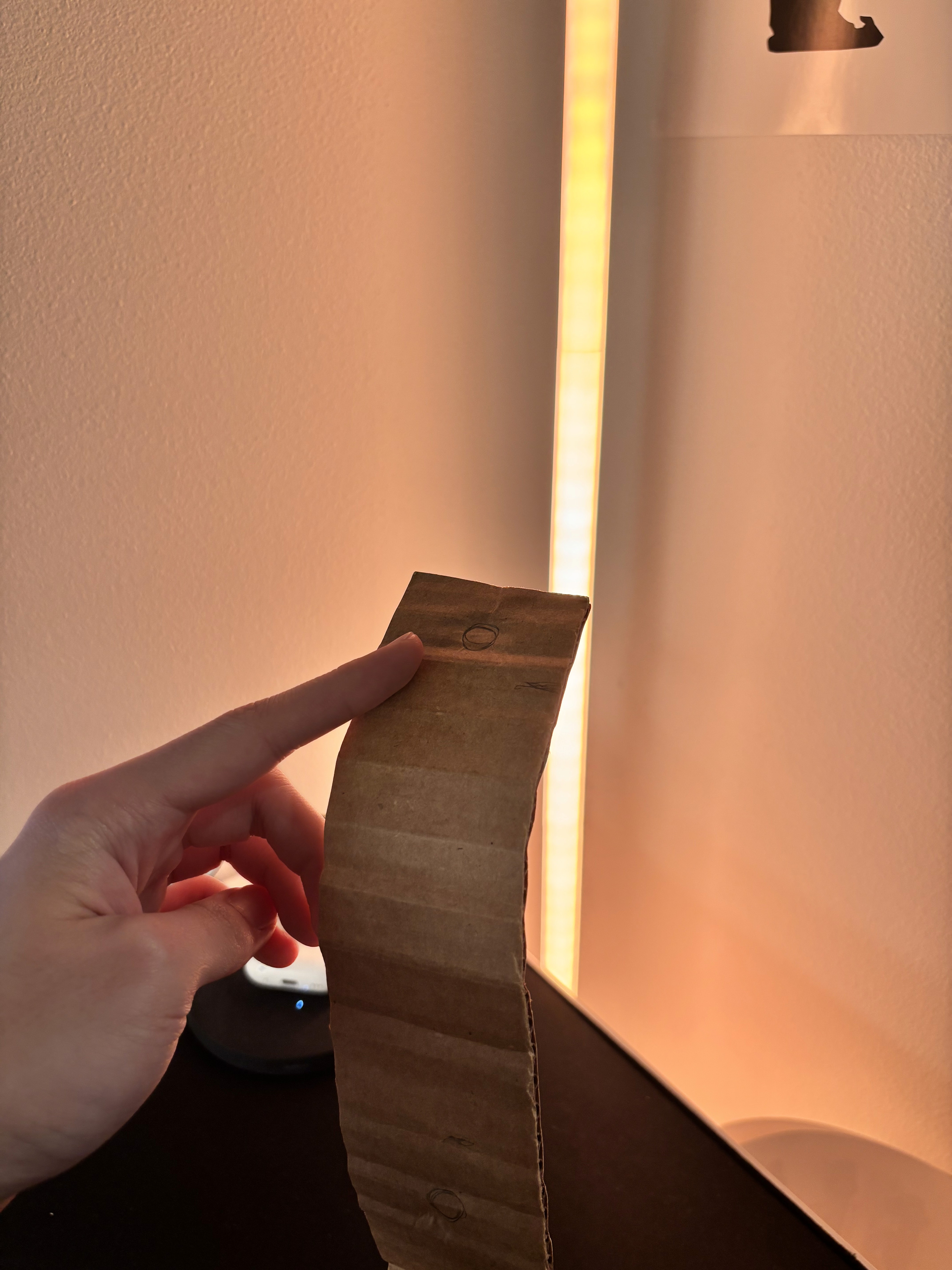
Held up to show the rod hole position. This is when I noticed the arm didn't need to be as long as I'd planned.
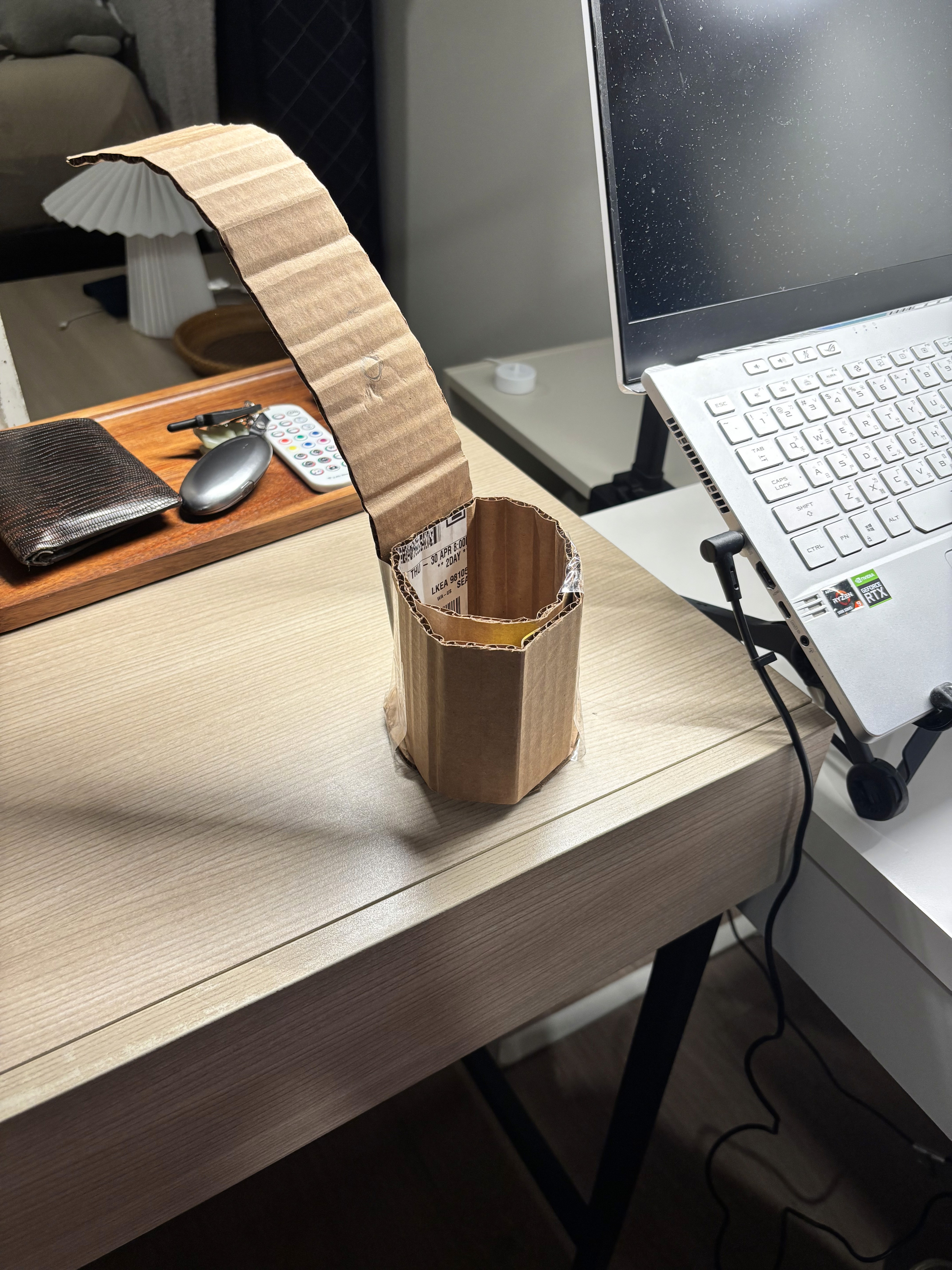
Side view showing the support-to-cradle geometry. The rough proportions matched what I'd later model.
Final Iteration
Constraints first, geometry second.
I modeled in Onshape. The cylinder first: 83mm inner diameter for standard cupholder sizes, 4mm walls, 90mm height to hold the bottom third of fast food fountain drinks, and a 4mm floor. The 20mm front slot with 3mm fillets adds the aesthetic gap. The vertical support extrudes flush from the top 20–25mm of the cylinder wall 8mm thick, 25mm wide with a 6mm fillet blending the junction.
The base plate is 40mm wide, 60mm long, 5mm thick. The rod hole is 17mm. My measured rod was 15–16mm, and FDM printers slightly undersize holes, so 17mm gives a clean slip fit. I printed the cylinder base-down to avoid support material entirely.
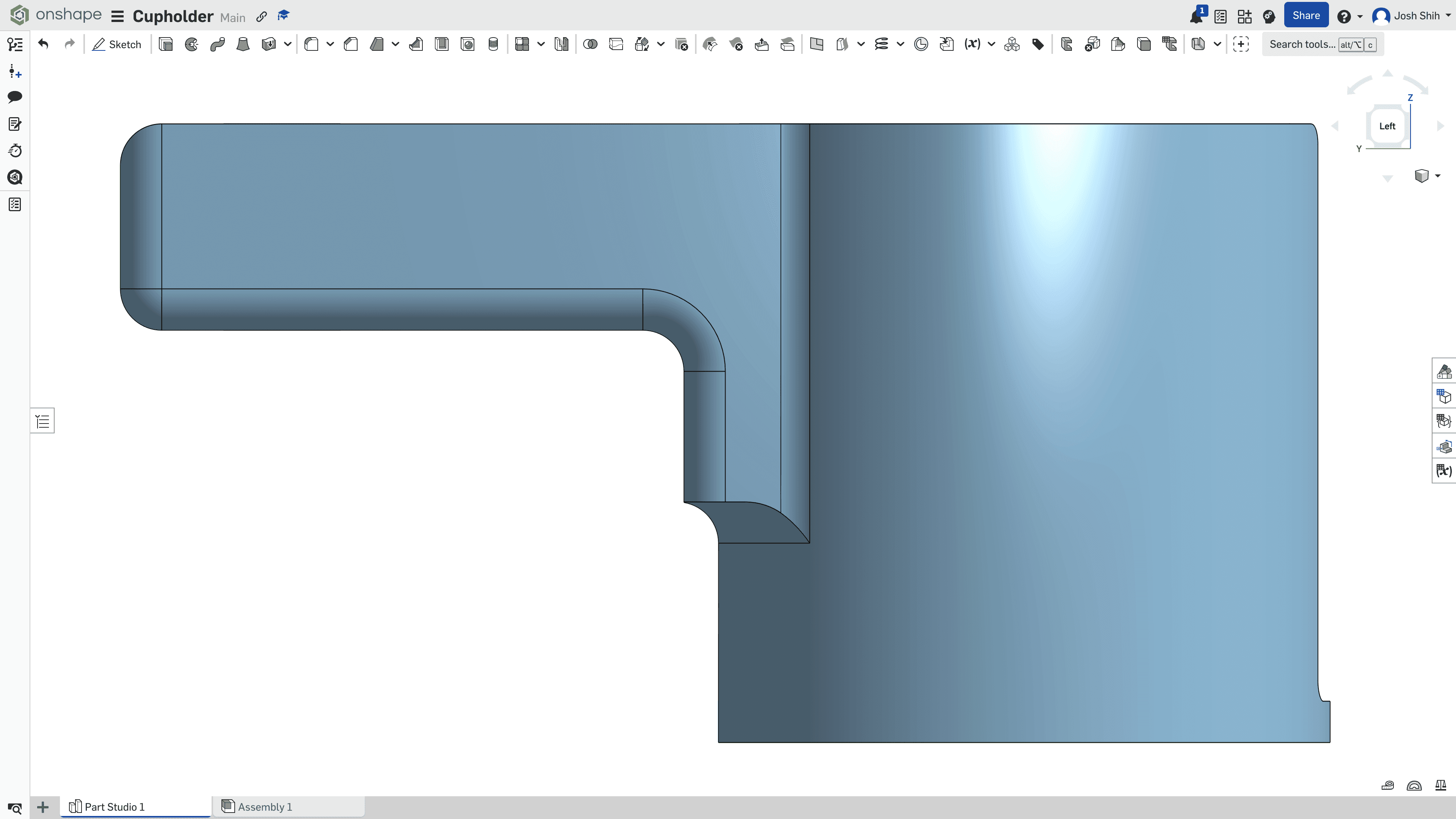
Onshape front view. Cylinder, vertical support, and base with rod hole. Support connects flush at the top rim.
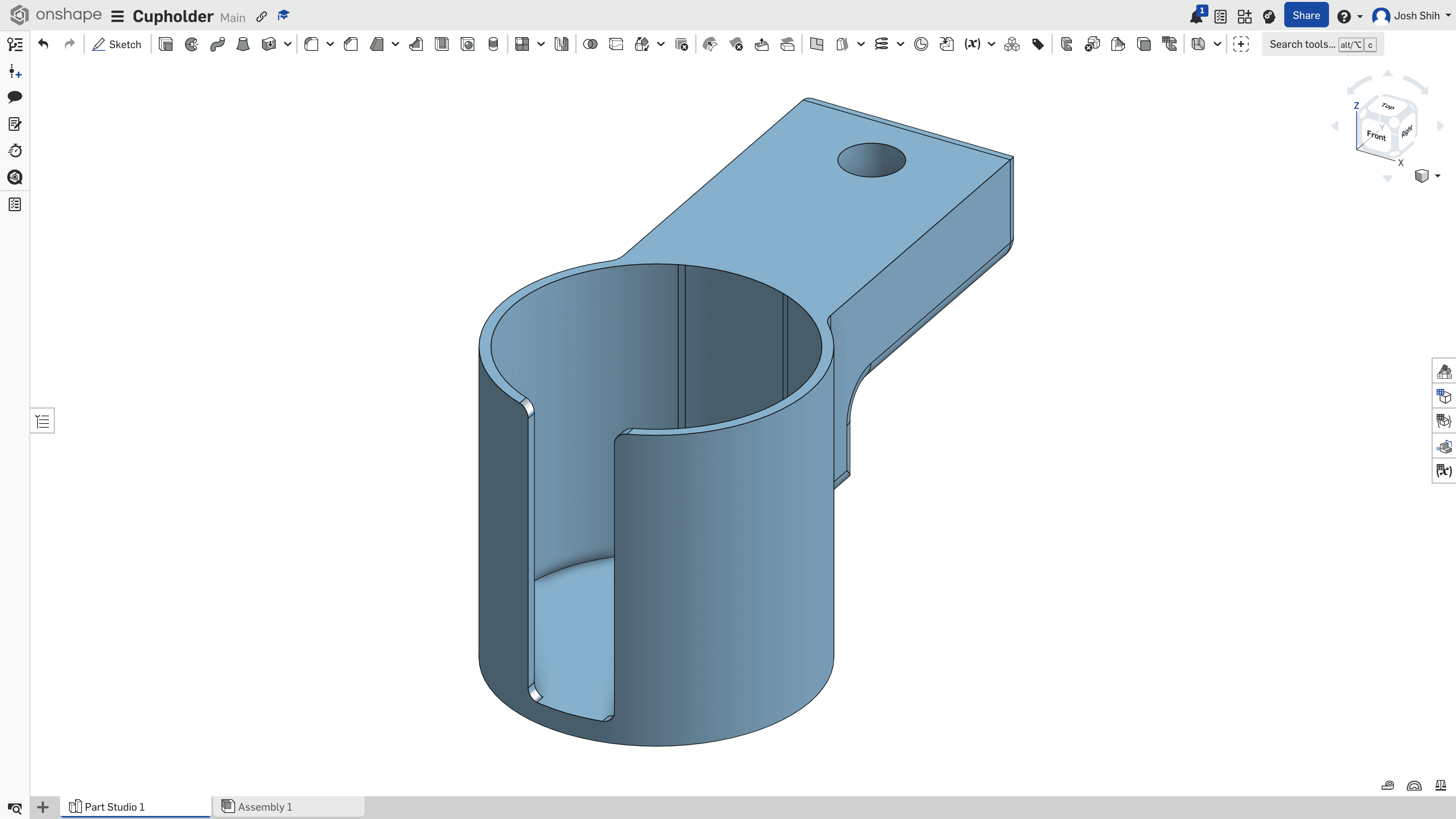
Onshape isometric view. 4mm walls, 20mm front slot with 3mm fillets, 6mm fillet at the support junction.
3D Print
One print that worked.
The hole seated onto the headrest rod on the first try, with no rework. I pushed the assembly sideways and it reacted with minimal movement. Then the real test, a cup of water. There was no tip or visible flex at the support junction, so for a one-and-done print, that felt like a win!
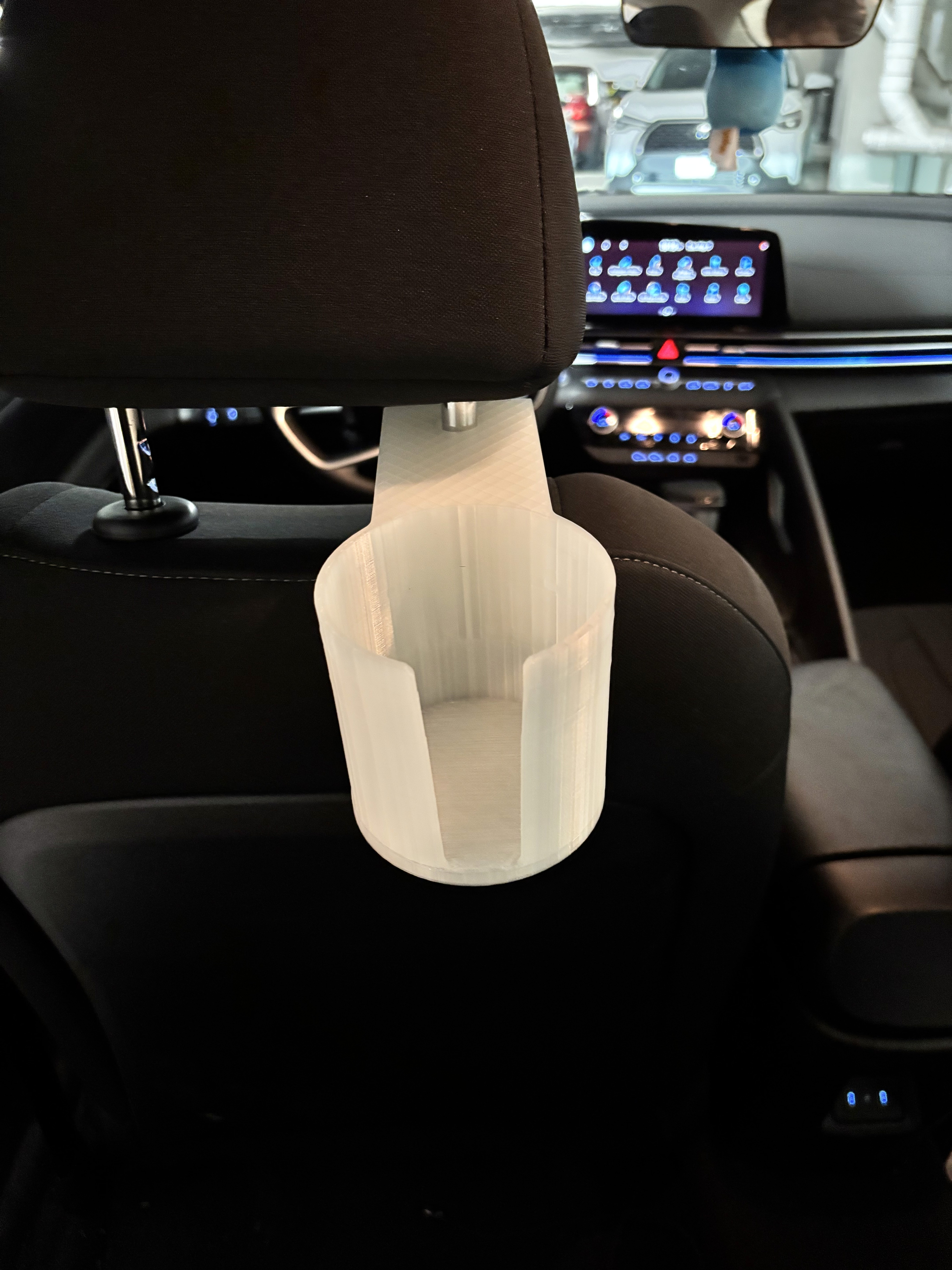
Installed on the passenger headrest rod. Base plate seats cleanly; no tools needed to install or remove.
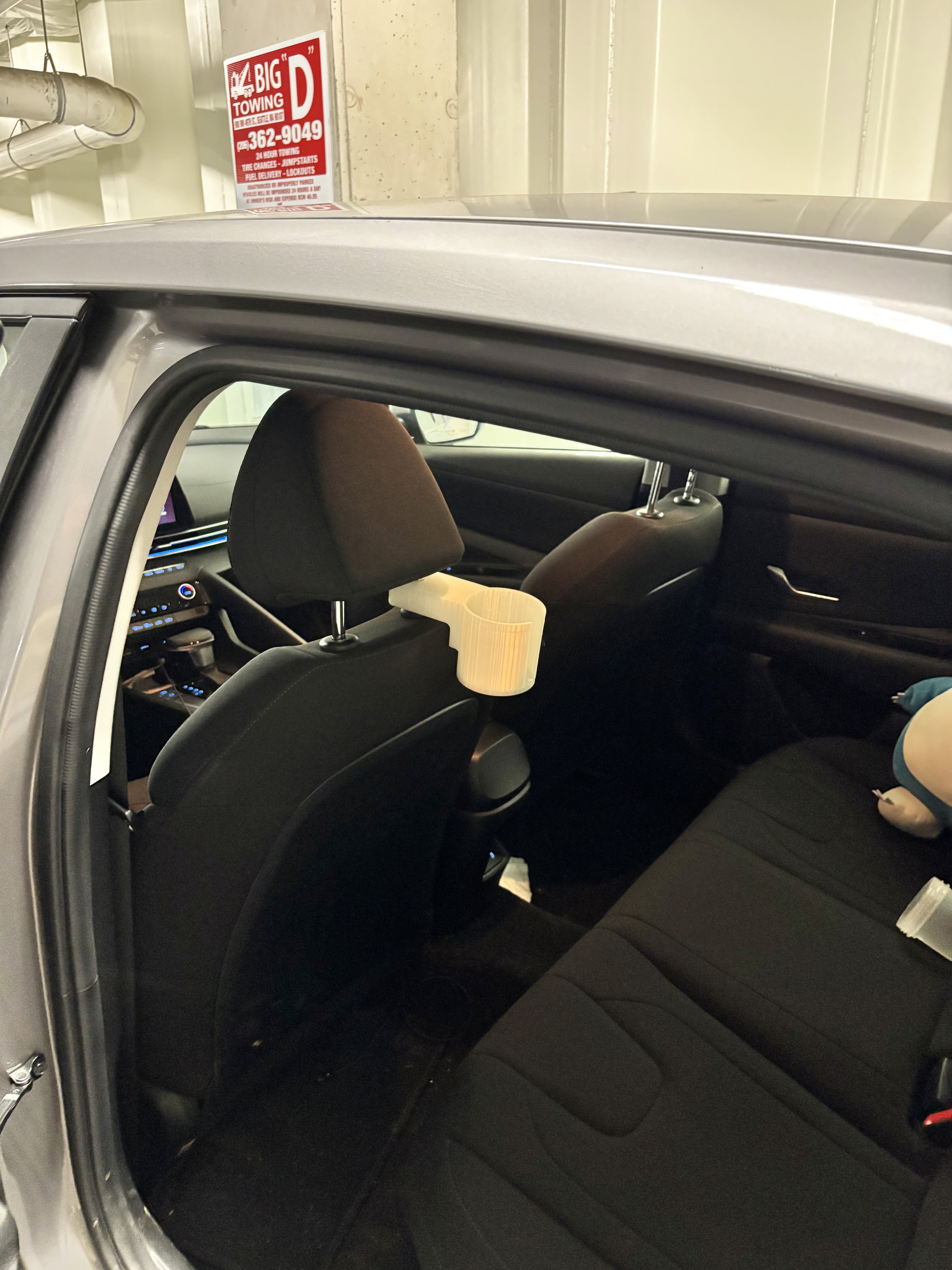
View from outside the car. The cylinder hangs beside the seat at a natural reach height for a rear passenger.
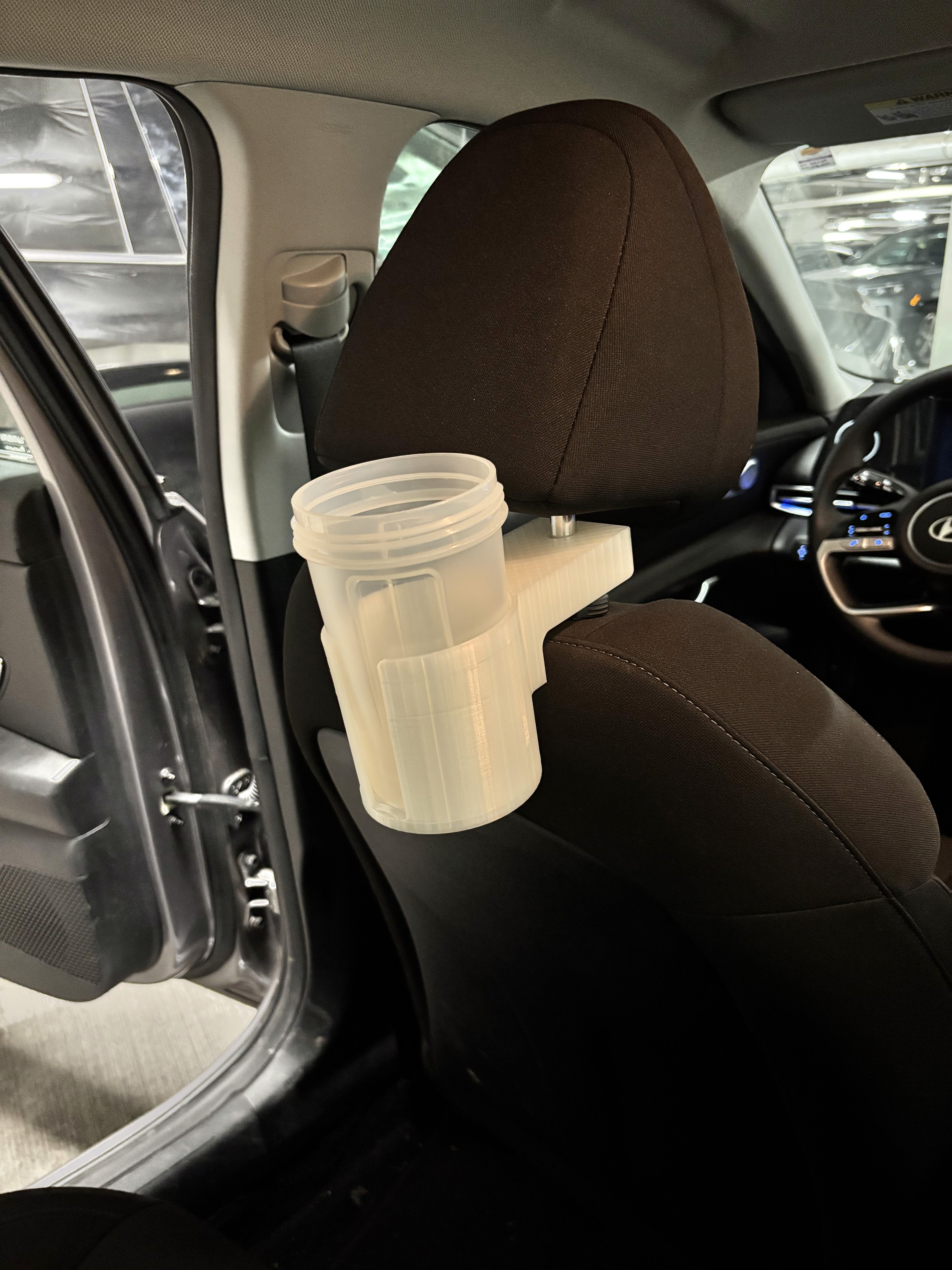
From the back seat. The cup sits where you'd actually reach for it. No modification to the car.
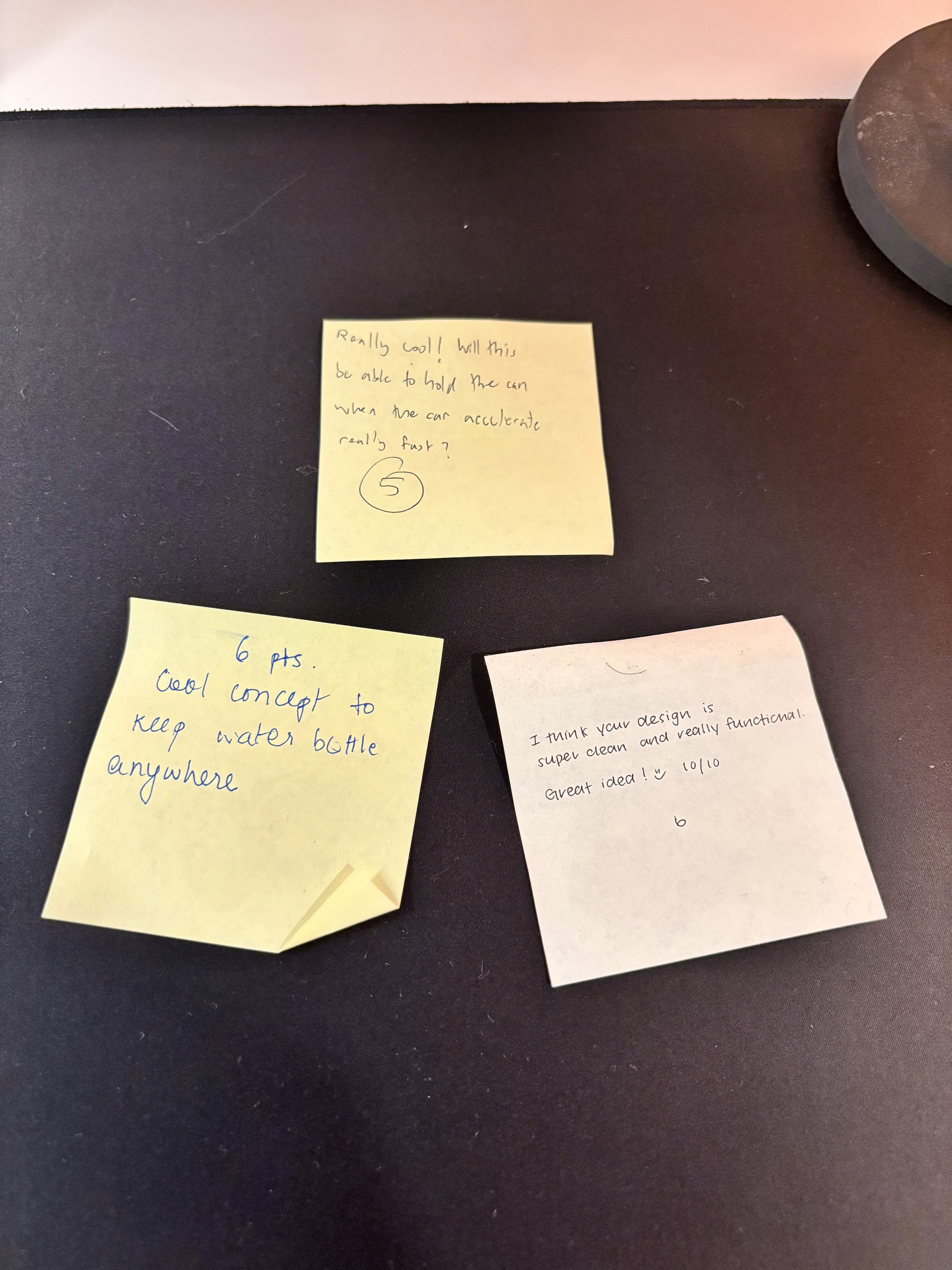
In-class gallery walk feedback. One peer noted hard acceleration as a risk. Two called it clean & functional.
In class, I set the cupholder up for a gallery walk critique. Two peers noted the clean design, one rating it 10/10 and calling it a "cool concept to keep a water bottle anywhere." The critical note asked whether it would hold a cup under hard acceleration. That was the most useful sticky note of the session.
Analysis
Testing against what actually mattered.
Feasibility held. The 17mm hole seated onto the 15–16mm rod cleanly, no tools needed. Pushing the assembly sideways showed minimal sway. The 6mm fillet at the support junction showed no whitening or cracking after a loaded drive.
For usability, I drove with a cup of water in the holder. The cup stayed through turns and stops. Reach from the back seat was natural. The one usability cost is install friction: the headrest has to come off to thread the rod through the hole. That takes about 30 seconds and only happens once per trip.
For desirability and impact, the gallery walk feedback was telling. Peers noted the clean aesthetic without any prompting, one rating it 10/10 with the comment "super clean and really functional." The one critical note asked: "will this be able to hold the can when the car accelerates really fast?" That question was more useful than the 10/10.
That acceleration question revealed the one gap testing didn't catch: hard deceleration with an open cup. I tested with water driving normally but didn't test an open cup under hard braking, which is the condition a fast food drink in a car might see. The next iteration needs a rubber grip lining inside the cylinder, or a partial lip at the top rim to retain the cup at speed.
The prototype proved the core concept works. The fit and load junction validated in one print. The gallery walk was the best outcome of the testing process: it surfaced a condition I hadn't thought to test, which is what user feedback is there for.
Reflection
What I'd tell myself at the start.
The back seat cup situation has bothered me on drives with passengers for a while. The assignment asked for something useful in everyday life, and this was genuinely that. It was something I'd build and use daily.
What I wish I had known before starting was to go sit in the back seat first. I spent real design time on a long support arm before I went out to the car. Five minutes in the back seat with a corrugated strip told me the headrest was already low enough and the whole geometry changed. Measure the environment before you design for it.
The biggest friction was Onshape. I'd never used it before, and the constraint-based workflow takes time to click. The first few hours were slow. I kept reaching for Cuttle habits, sketching without planning constraint relationships, and had to redo work when dimensions wouldn't propagate the way I expected.
What I enjoyed was the single-print success. The previous assignment took two cardboard rounds before the laser, and even then produced a miscut. Getting a printed part that fit and worked on the first try, for something with a real tolerance requirement, felt genuinely satisfying.
On the software: Onshape's constraint-based sketching is the right tool for any project where a specific dimension has to drive the rest of the model. Driving the rod hole from one measured number and having it propagate through the base plate geometry is exactly what this project needed. The cons are the learning curve and the browser dependency. A dropped connection mid-session is a real risk when there's no local file. For flat parametric work, Cuttle is faster. For 3D revolved bodies with tolerances, Onshape is the correct choice.
AI
AI usage.
Claude assisted with dimensional decisions throughout the design process, including cup diameter standards, rod tolerances, wall thickness, fillet sizing, and support geometry. Claude also used the Framer MCP to structure and publish this process log.